Limits to Green: a Comic about the earth
-
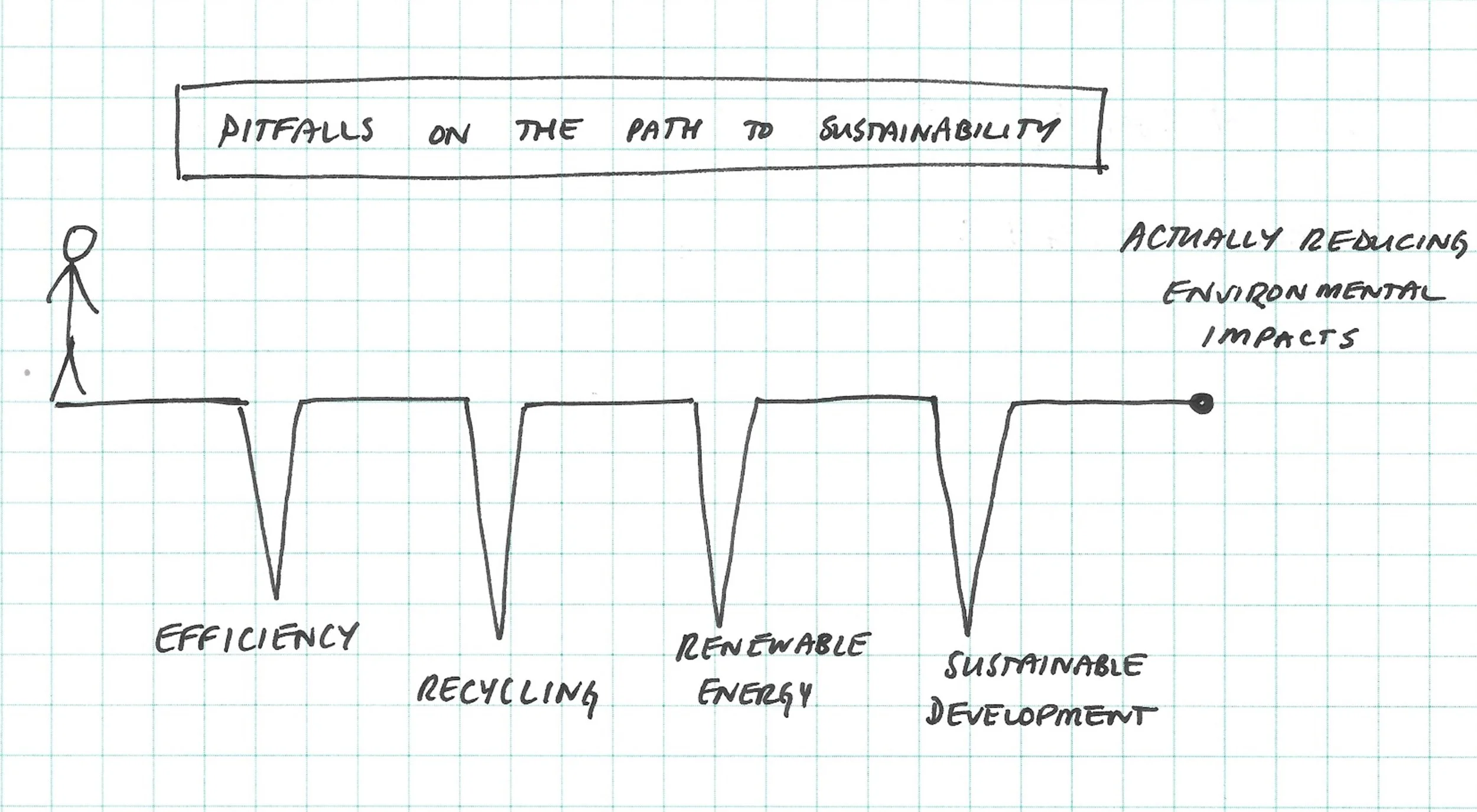
#1: Pitfalls
Some non-analytic sketching in my lab book this week... questioning the ability of clean green buzzword concepts to deliver true sustainability.
-
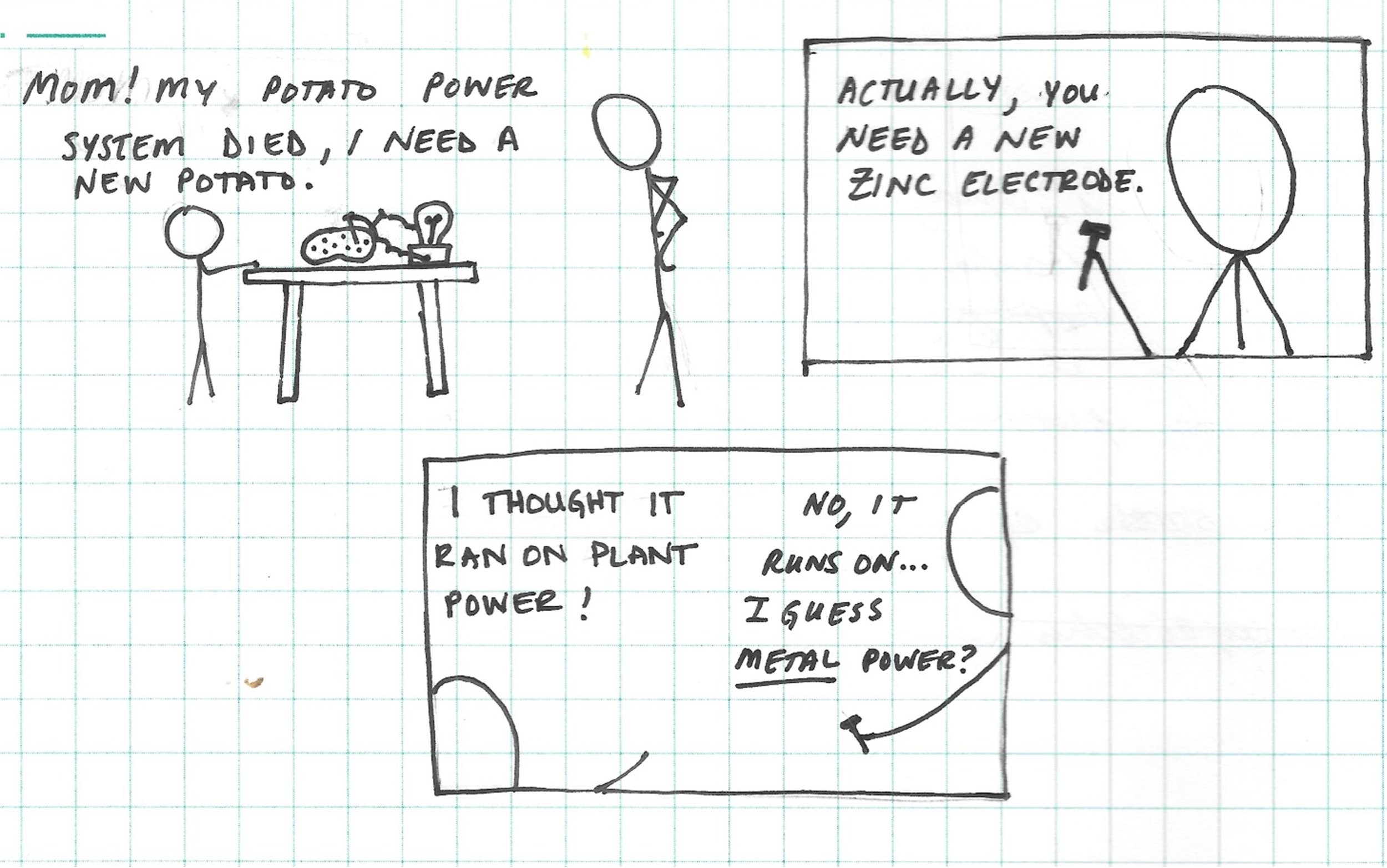
# 2: Metal Power
Renewable energy is not simply "clean" or "green" or "carbon free." Its real character is like the "potato-powered" light bulb you may have constructed in elementary school. The potato was part of the equation, but what actually powered the light bulb was the transfer of ions between zinc and copper nails. If your teacher called it "potato power", that was misleading.
Solar, wind, hydro, geothermal... all of these "renewable" energies are made available using materials, such as batteries and capacitors, that do the work of managing, transporting, storing, and imparting energy for final use. So there are an array of non-renewable materials at the heart of renewable energy, mostly metals. And no, we can't use potatoes instead. -
#3: More than Enough
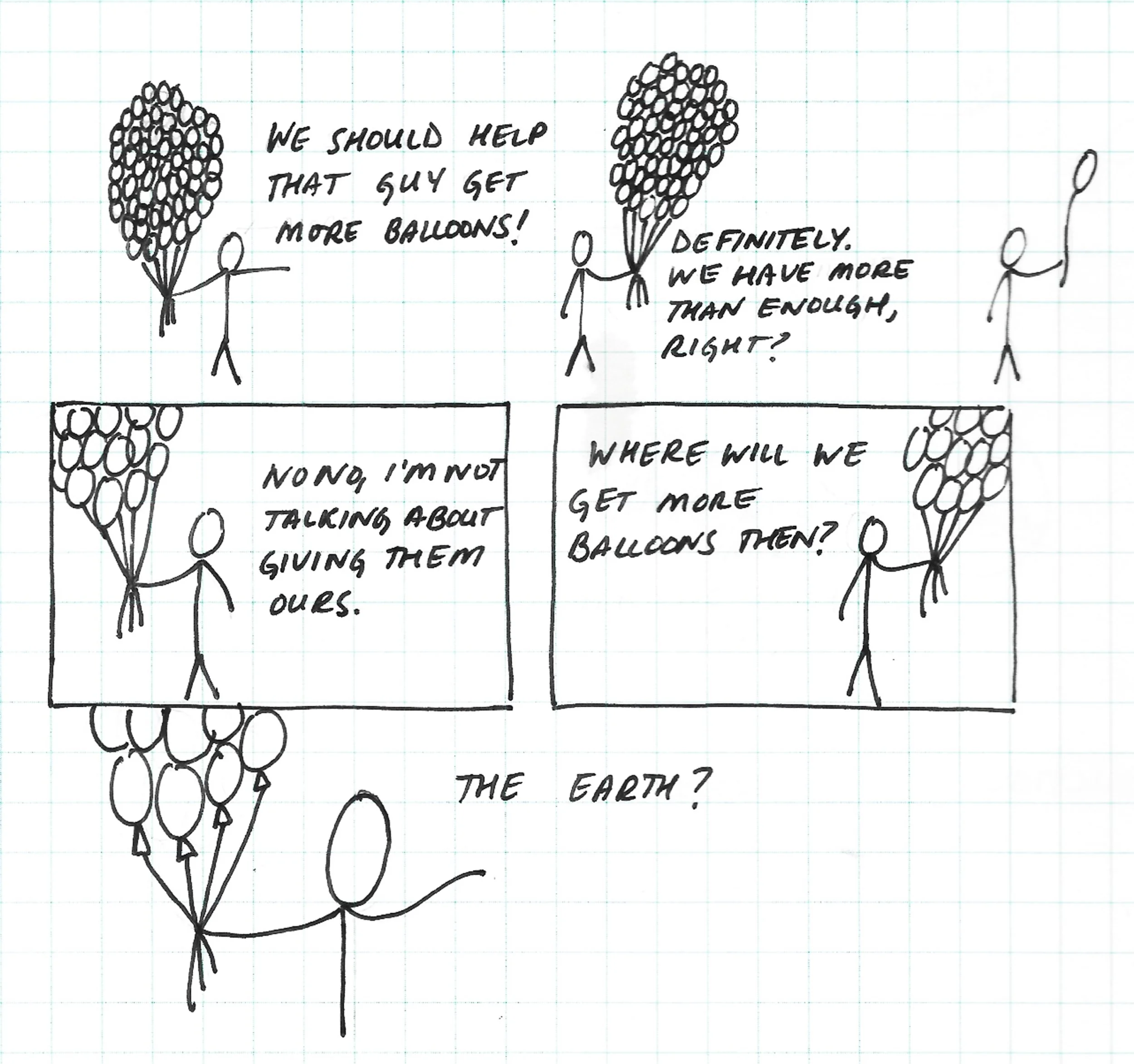
I find that most Americans who talk about sustainable development are not truly ready to give up their extreme wealth to make ecological space for others. Without confronting our ecologically irresponsible affluence, the Sustainable Development Goals cannot succeed.
The conundrum is depicted here, with balloons representing ecological footprint. The average middle-income American has a footprint about 100x the average in a "developing" country". -
#4: Also Trees
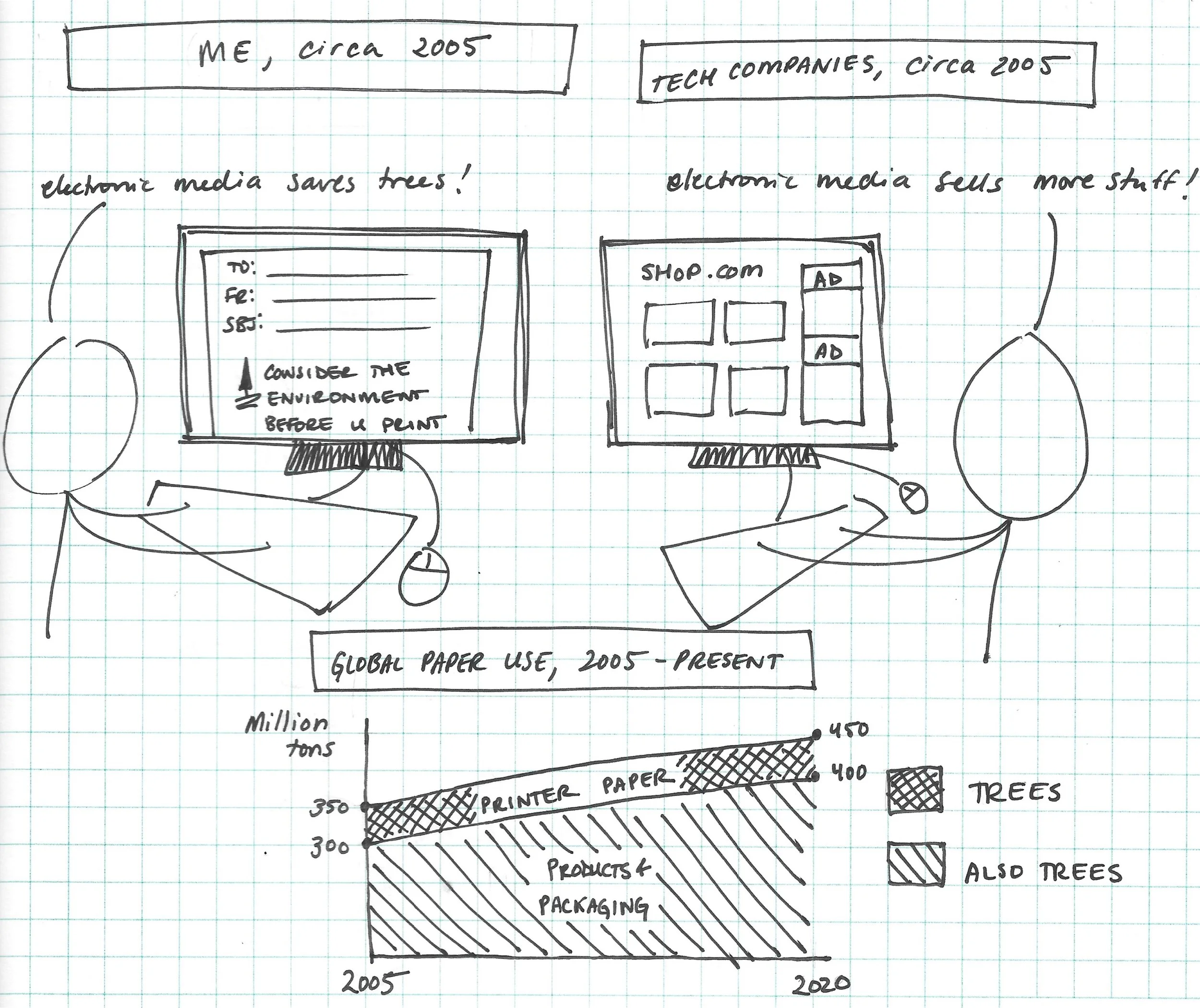
In 2005 we were hoping that e-mail and electronic media would reduce paper use. Almost two decades later what we have is more and more of the Earth extracted, processed, packaged in cardboard boxes, and delivered to our doorsteps.
Graph of paper industry data based on:
McKinsey, 2019. “Pulp, paper, and packaging in the next decade: Transformational Change.” -
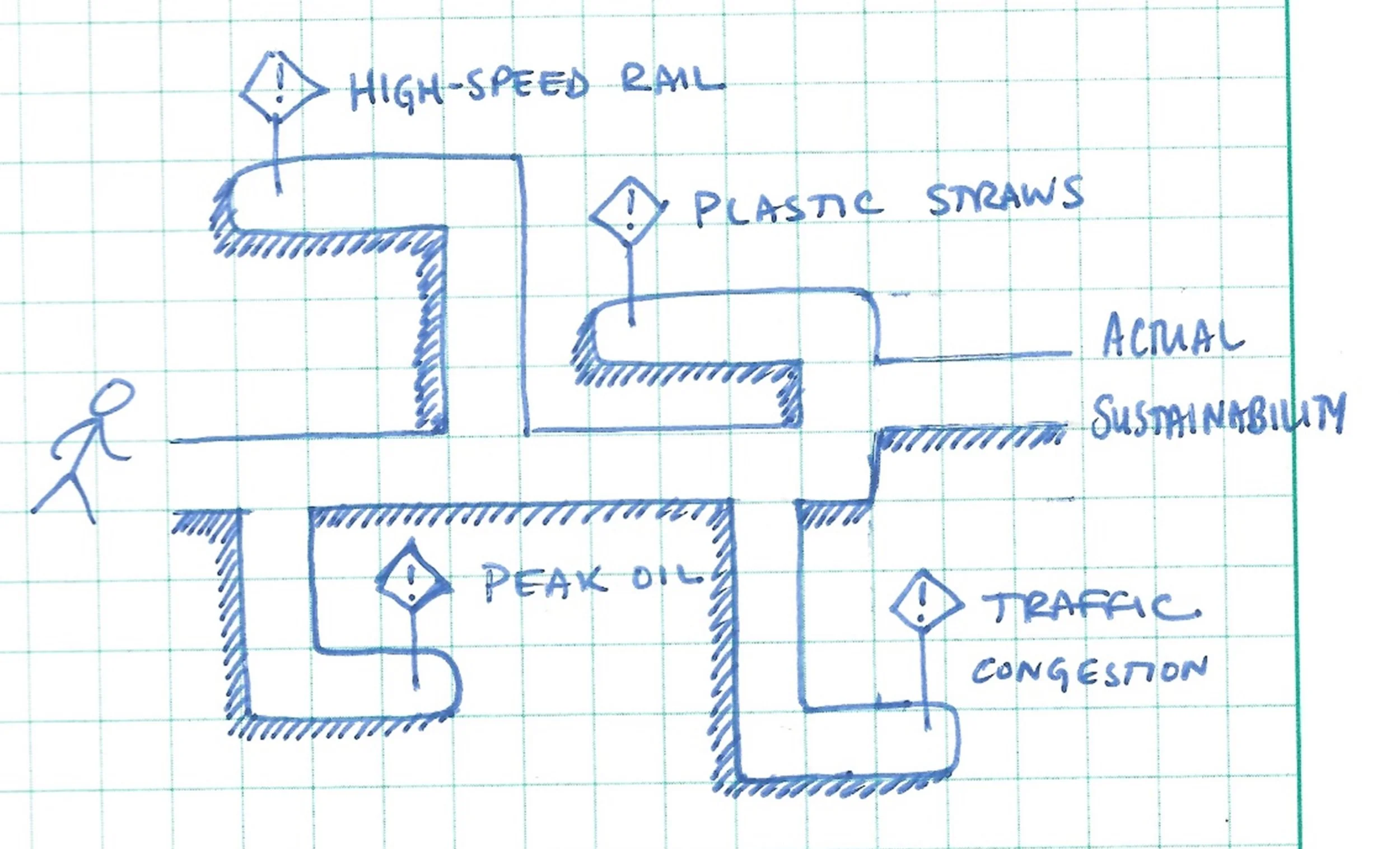
#5: Dead Ends
I have spent a lot of time working on and worrying about traffic, plastic waste, and peak oil, among other buzz-topics in sustainability. I now see them as dead end concepts. They seek alternatives within a context of high-disposability material and high-power energy.
Some examples:
- Compostable straws to replace plastic ones
- High-speed rail to replace airplanes
- Autonomous vehicles to replace traffic congestion
- Utility-scale batteries to replace fossil fueled power generation
High-disposability and high-speed are facets of our economic structure that must change in order to enable true sustainability. Without confronting our systemic demand for speed and convenience, we will continue to claim more and more of the Earth System for ourselves. The ultimate dead end. -
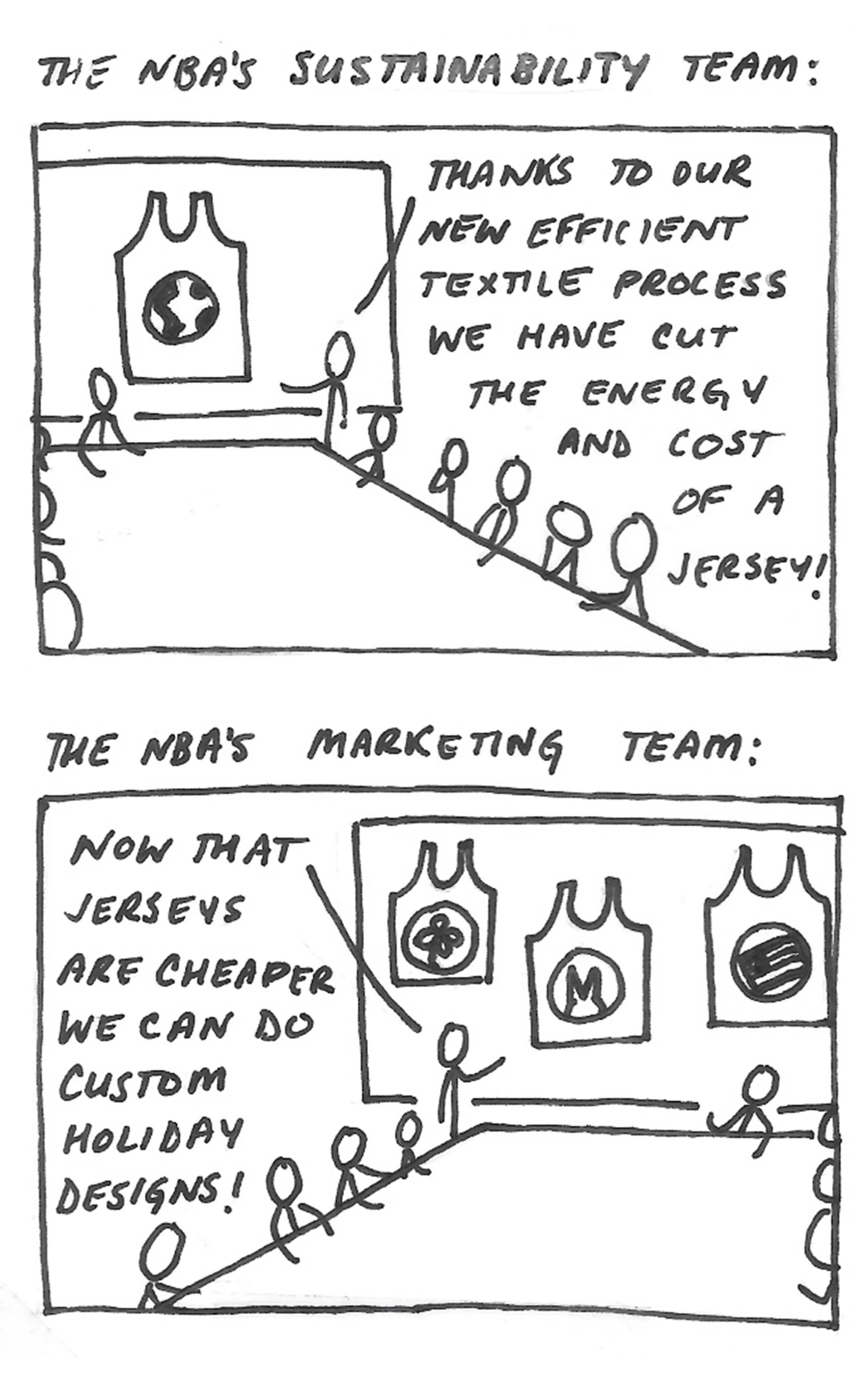
#6: Sustainability or Marketing?
We hear a lot about "win-win" technologies and the "triple bottom line." Save money, save resources, save the planet. Unfortunately, without hard limits on energy and resource extraction, humanity finds all sorts of little ways to put those savings to use. Sometimes they are innocent things, like holiday-themed jerseys, that supposedly bring joy to our lives.
That's why your individual consumption choices and even company-level win-wins are not great places to focus our attention. We need enforceable resource extraction limits with global reach.
PS - I'm using this as an example of how normal and non-evil it is to grow our resource use. Also how difficult it is to pinpoint where and how the "jevons paradox" or the "rebound effect" actually occur. -
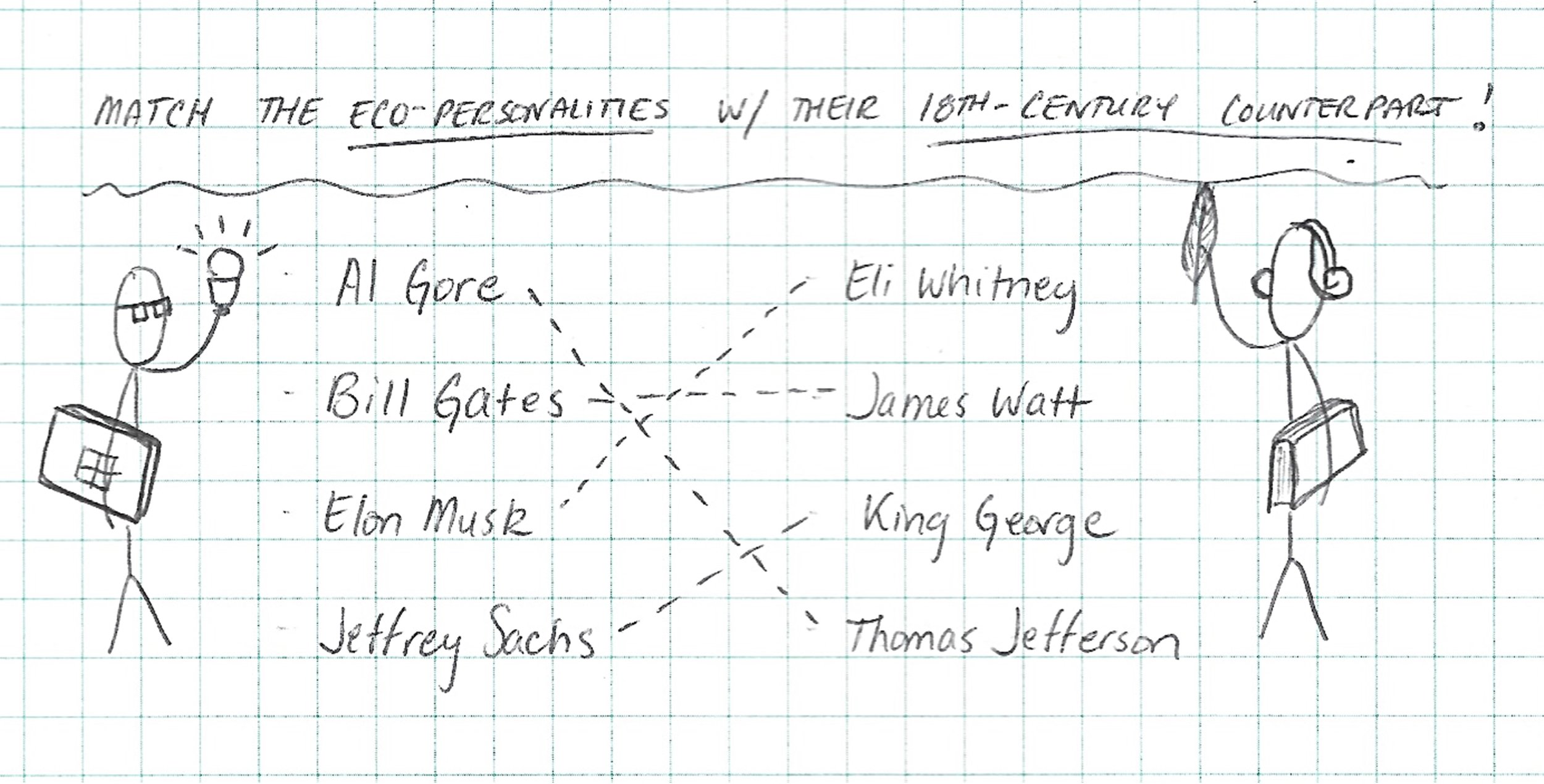
#7: Eighteenth Century Figures
Bill Gates' book How to Avoid a Climate Disaster is listed as a Top 20 bestseller for environmental science on Amazon. And yet, in the early part of the book I read this: "there's nothing wrong with using more energy, as long as its carbon-free." Totally ignorant about how materials are transformed into useable energy via a necessary degradation process. Basically, thermodynamics.
These celebrity-personalities that we have come to associate with the environmental movement are not really environmental thinkers. They are well-spoken industrialists promoting specific technologies and growth-based cultural norms. You will find people like them throughout history. I chose a handful of late 18th Century figures to compare them to. My justifications are in the comments. -
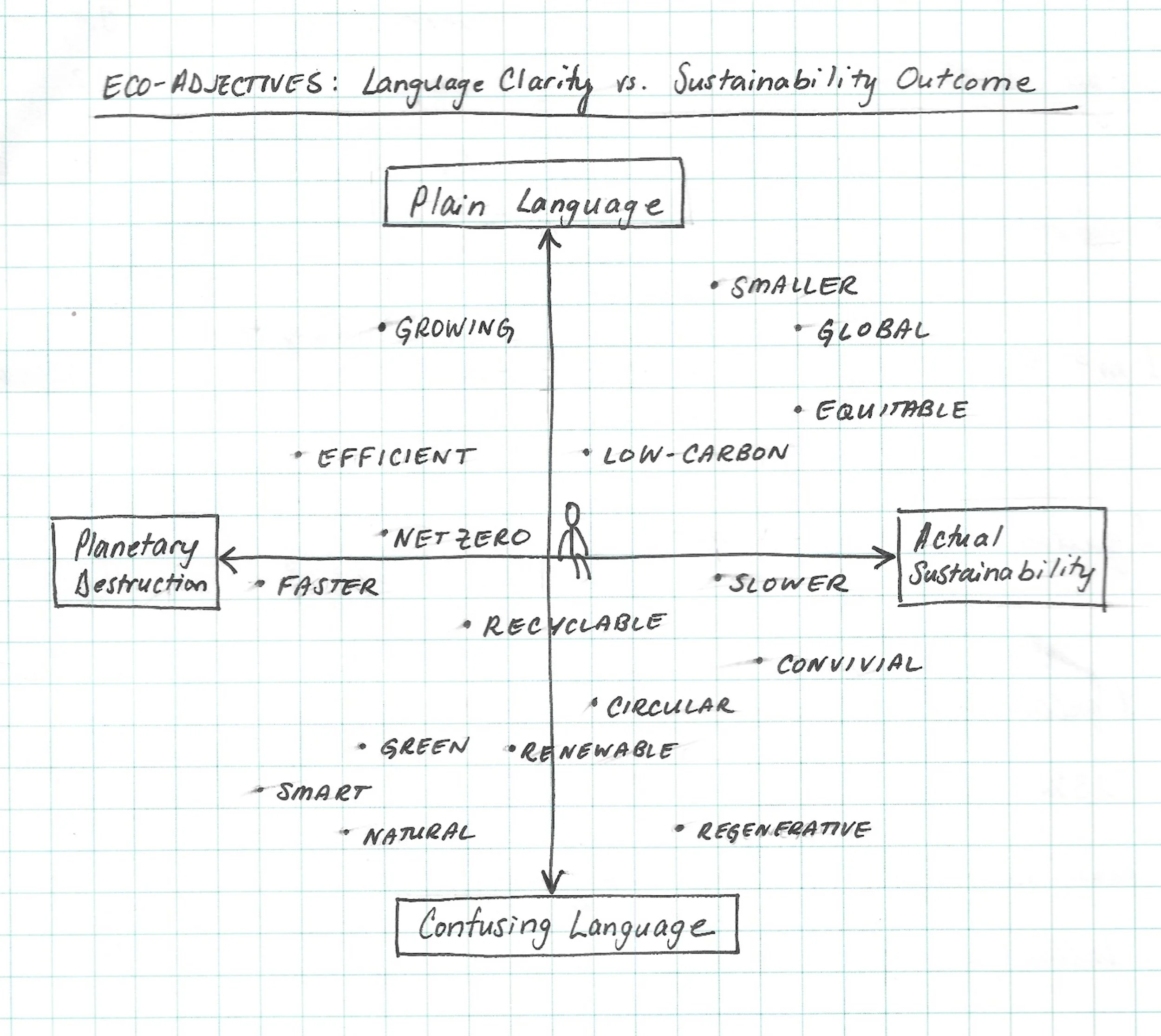
#8: Plain Language
In my 15 years of environmental work, I have used every eco-adjective on this graph to communicate sustainability concepts. Nowadays I aim to be in the top right quadrant as much as possible! Here's how this brainstorm graph works:
↔ the x-axis spans from "Planetary Destruction" to "Actual Sustainability" describing the degree to which the concept generally points toward real, global reductions in environmental impact
↕ the y-axis spans from "Confusing" to "Plain", describing the level of clarity communicated by the word -
#9: Tipsy Planet
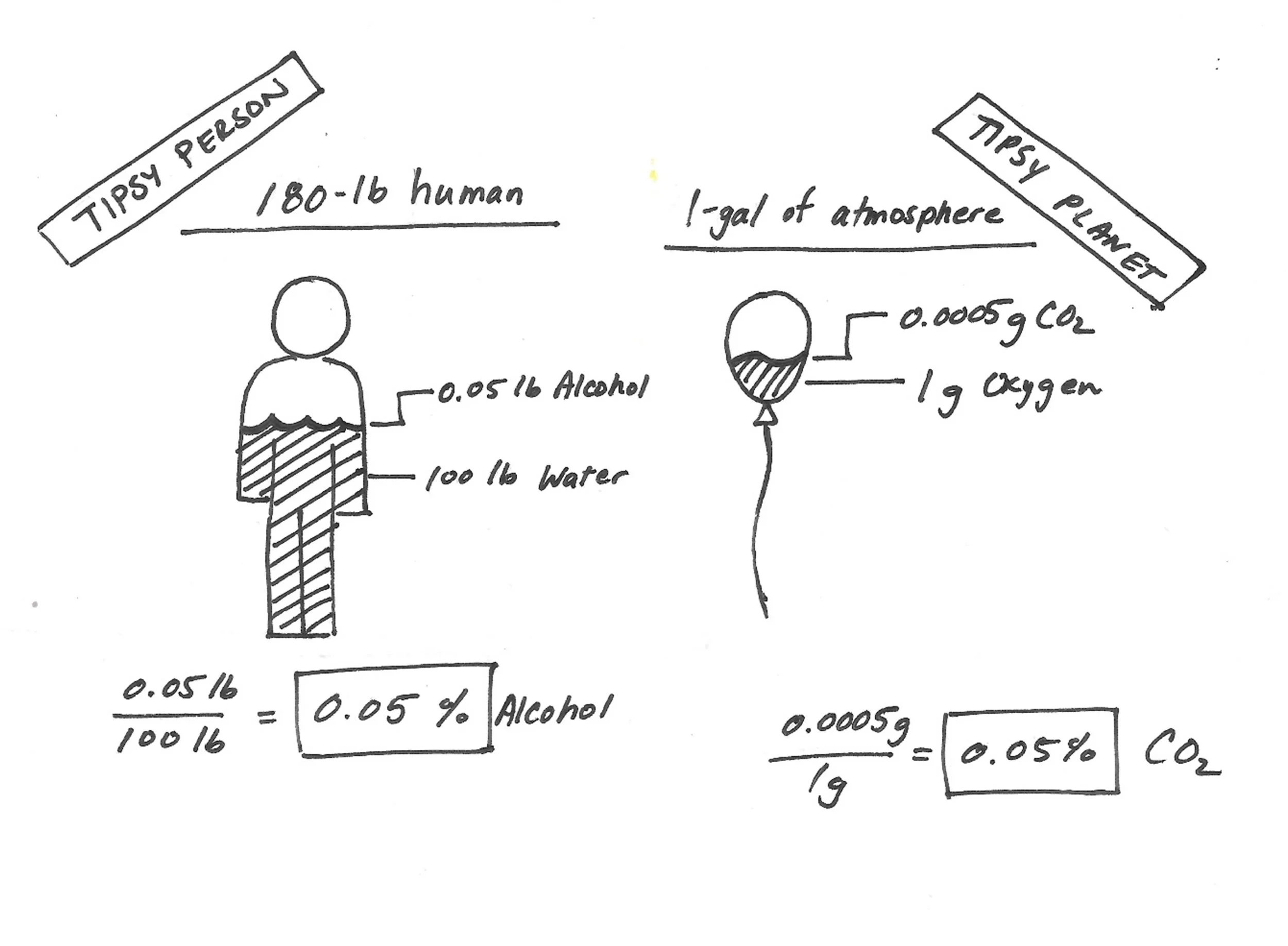
It doesn't take much for humans to have a massive effect on the Earth System. By diluting the atmosphere with just a little bit of carbon (we've added about 200 ppm above normal levels) humans have created climate change, a global disaster.
The analogy is me, a 180-pound person, drinking a beer. After 1 pint of average alcohol-content beer, I start to lose motor control, judgement, and hopefully my car keys. The numbers are very similar to those for carbon in the atmosphere. The ratio of alcohol to water in the body of a tipsy person (0.05%) is roughly the same as the ratio of CO2 to Oxygen in the atmosphere.
Don't operate vehicles while under the influence. Including the spaceship we live on. -
#10: Cleantech Hopefuls
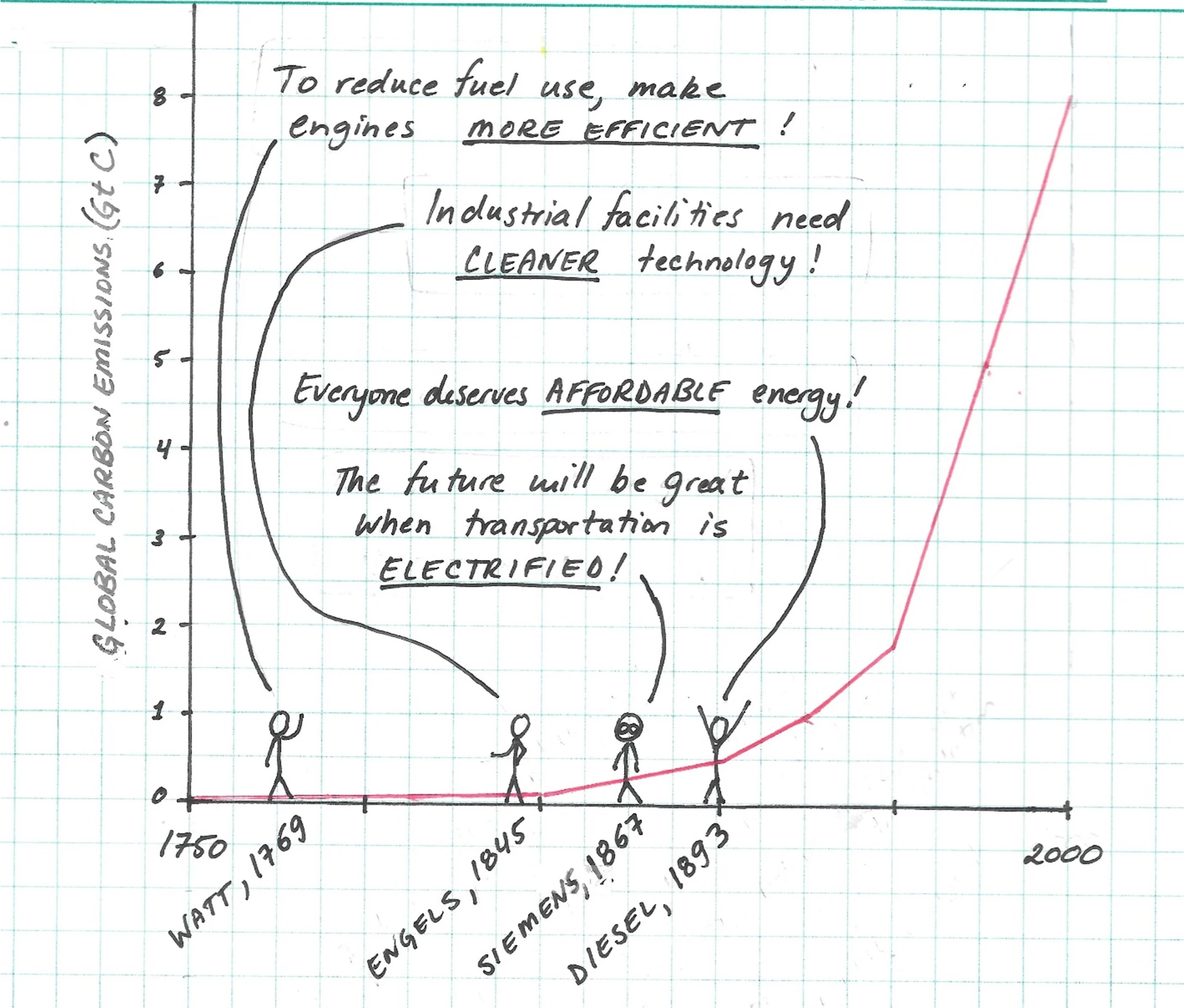
CLEANER, MORE EFFICIENT, AFFORDABLE, and ELECTRIFIED. These were prominent features of the innovation conversation over a century ago. That’s when the industrial growth patterns that are now destroying the planet were just taking shape at-scale.
If we want these buzzwords to drive actual environmental reductions, at a global scale, then we need a global cap on resource extraction and use.
About the graph:
- red line depicts global carbon emissions from human activity, from 1750-2000.
- some famous technologists are staged along the time-axis, with a modern paraphrase of ideas they published in that year. -
#11: Why are you wasting?
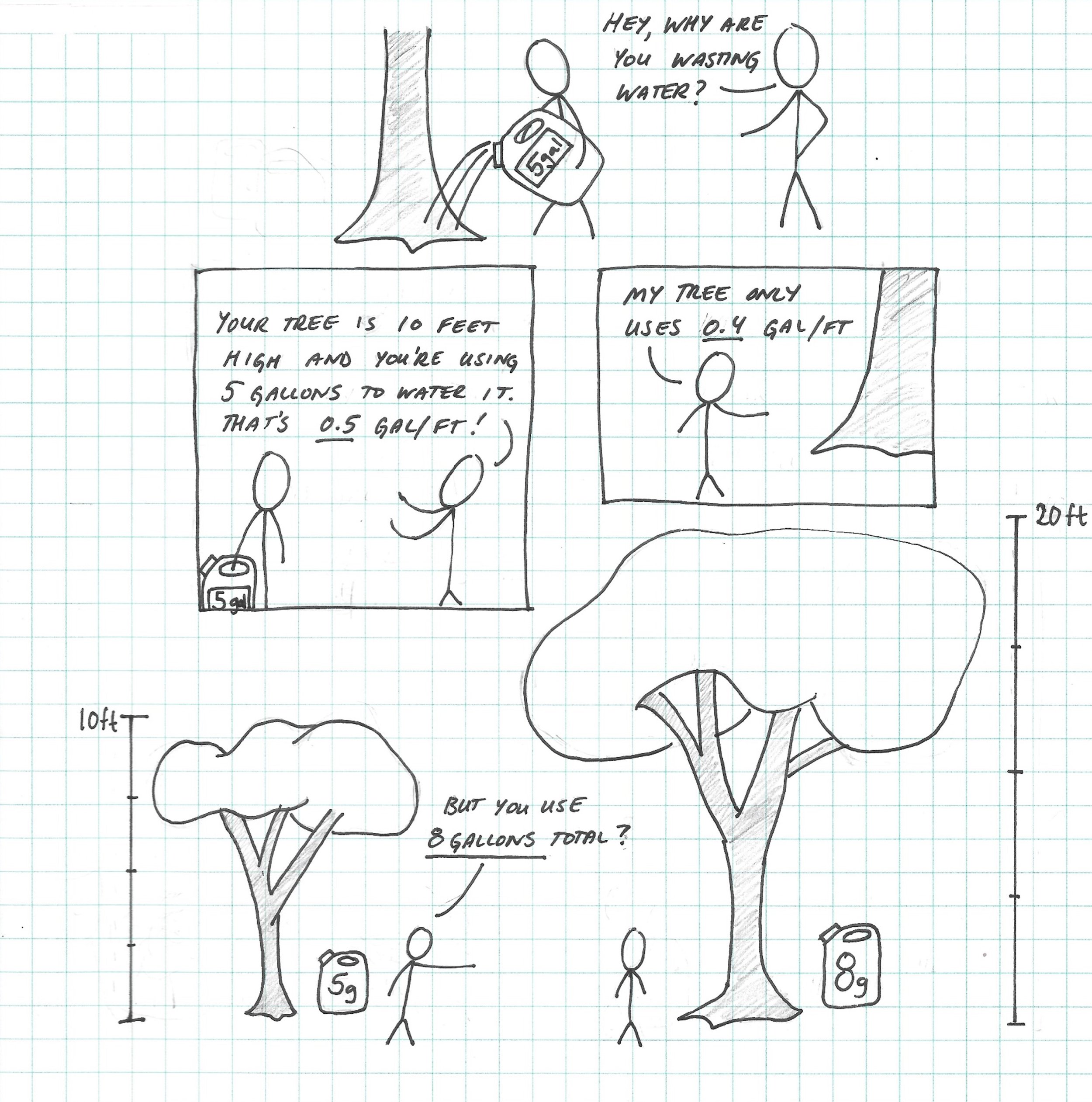
Does efficiency stimulate growth or does growth create efficiency? Either way, efficiency metrics tend to be a distraction from what's really going on. If you want to impact the Earth less, then its the TOTAL quantity of resources taken from it that matters.
-
#12: My Car Runs On
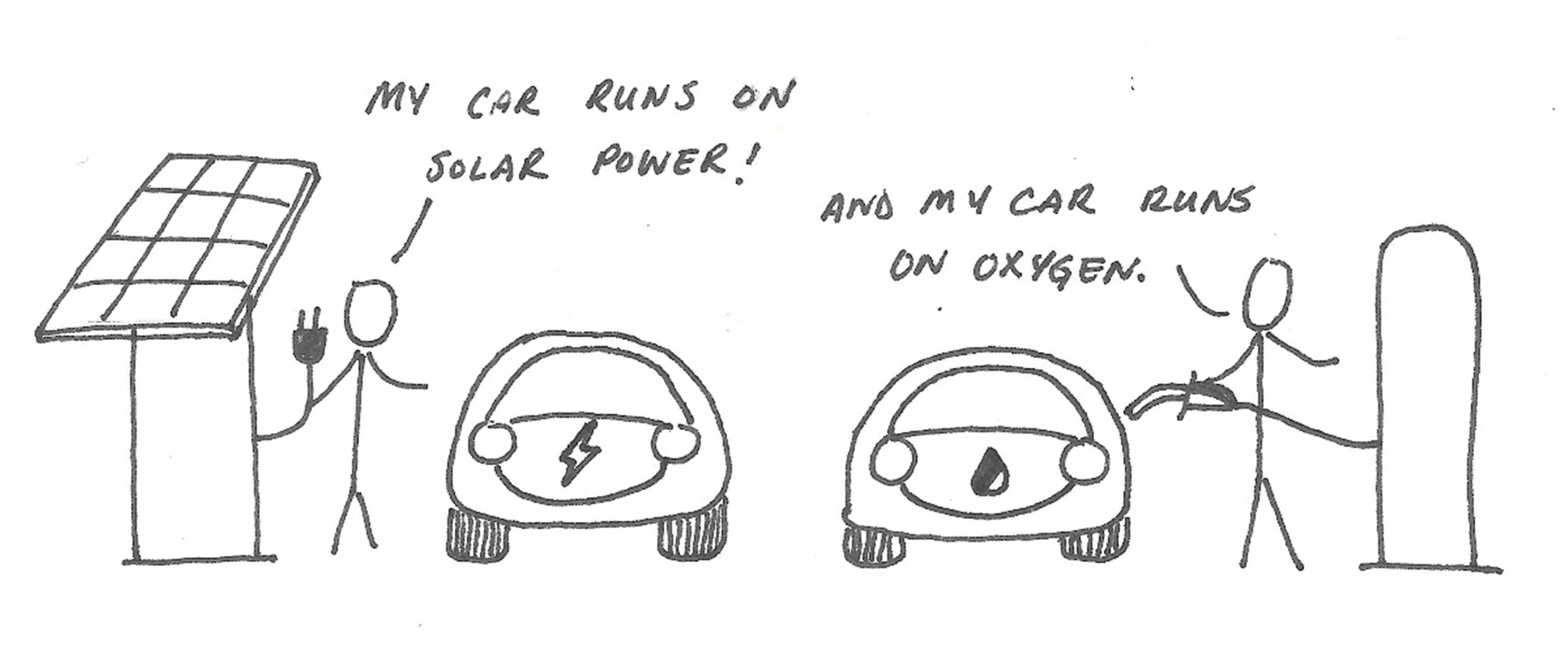
Both of these drivers are saying something partially correct and purposely deceptive.
-
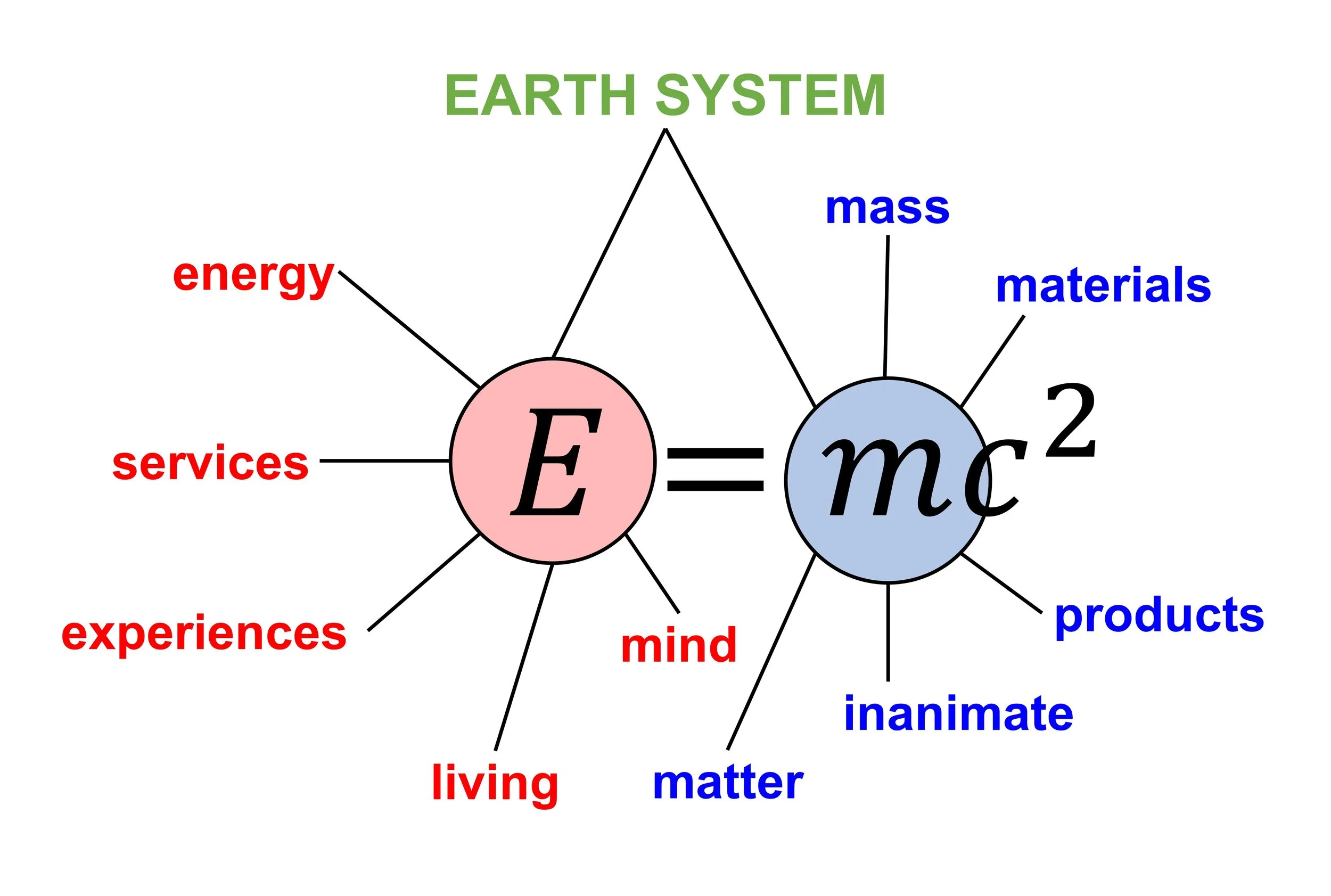
#13: Services Equal Products
Everything we do requires resources from the Earth System. We hear a lot about shifting from products to services or replacing things with experiences as ways of reducing our impact. Many digitalized "environmental" solutions are based on a promise of dematerializing the economy. At the end of the day, it all requires energy (E) AND materials (m).
More fundamentally, E and m are interconvertible (thank you Einstein). And since everything ultimately comes from the Earth System, then we cannot depend on substituting services for products as a sustainable solution. We must seek LESS demand for both, humanity-wide. -
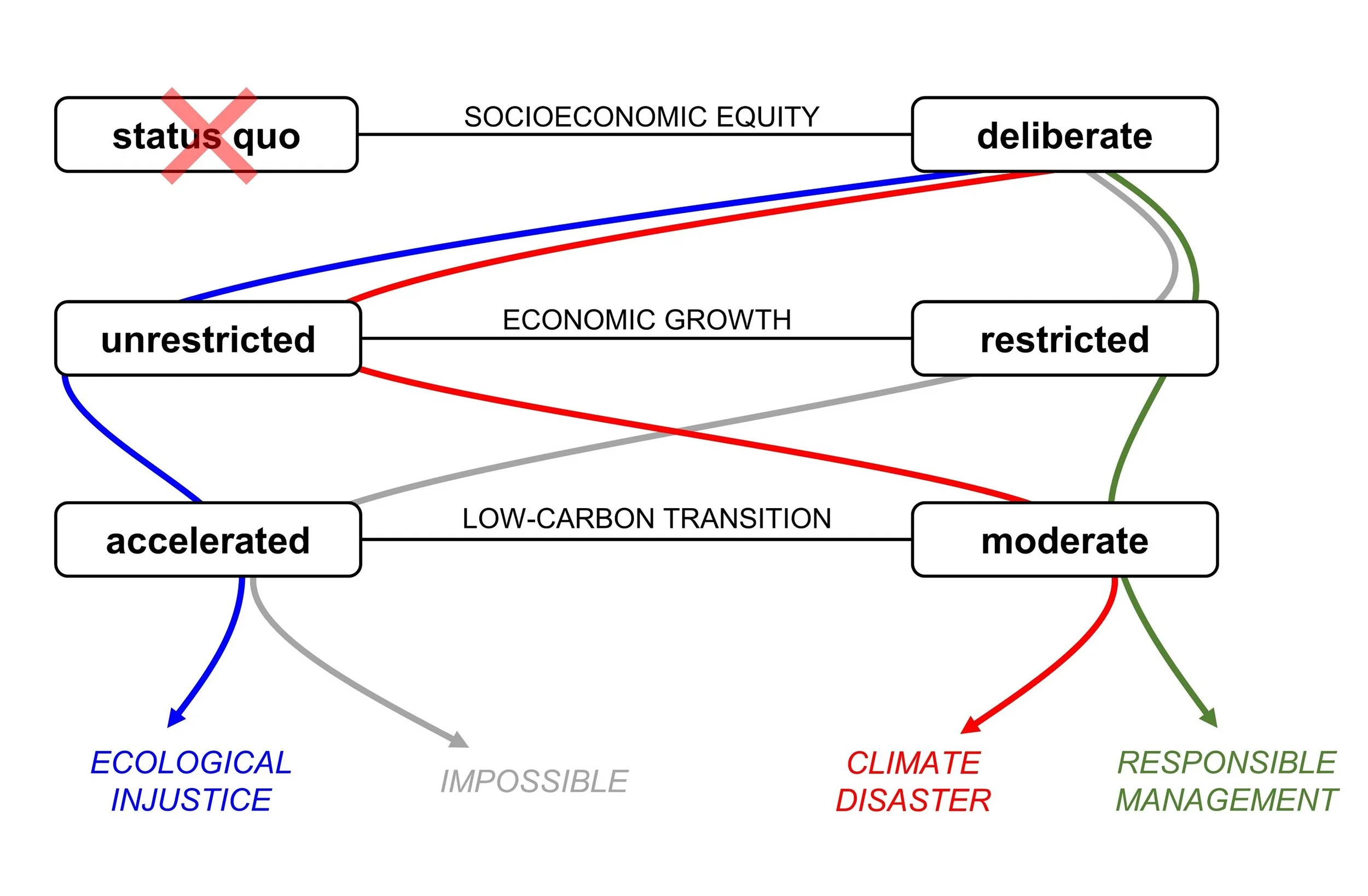
#14: Decision Tree
What if we view SOCIETY, ECONOMY, and ENVIRONMENT not as "bottom lines" to be maximized but as nodes on the path to a just climate solution? This concept gives us four possible paths to imagine:
All paths start with deliberately pursuing socioeconomic equity, because the status quo is not acceptable. From there,
🔵BLUE path: Pursue unrestricted growth and an accelerated low-carbon transition. Without precaution, this will simply shift the massive burden we currently put on the atmosphere to the mines and landscapes required for clean and green technologies. This path ends in different, but equally unacceptable ecological imbalance/injustice.
⚫GRAY path: Restrict growth but pursue an accelerated low-carbon transition. The popular vision of a transition to clean/green energy is a growth concept involving the rise of long-range personal EVs, high-power renewables, and efficient on-demand manufacturing. This vision is irreconcilable with restricted growth.
🔴RED path: This is the obvious one: Pursuing unrestricted growth without rapidly overhauling our energy system leads to climate disaster.
✅GREEN path: Restrict growth and transition to low-carbon infrastructure deployed with precaution and at an appropriate scale. Fair to label this "Responsible Management?" -
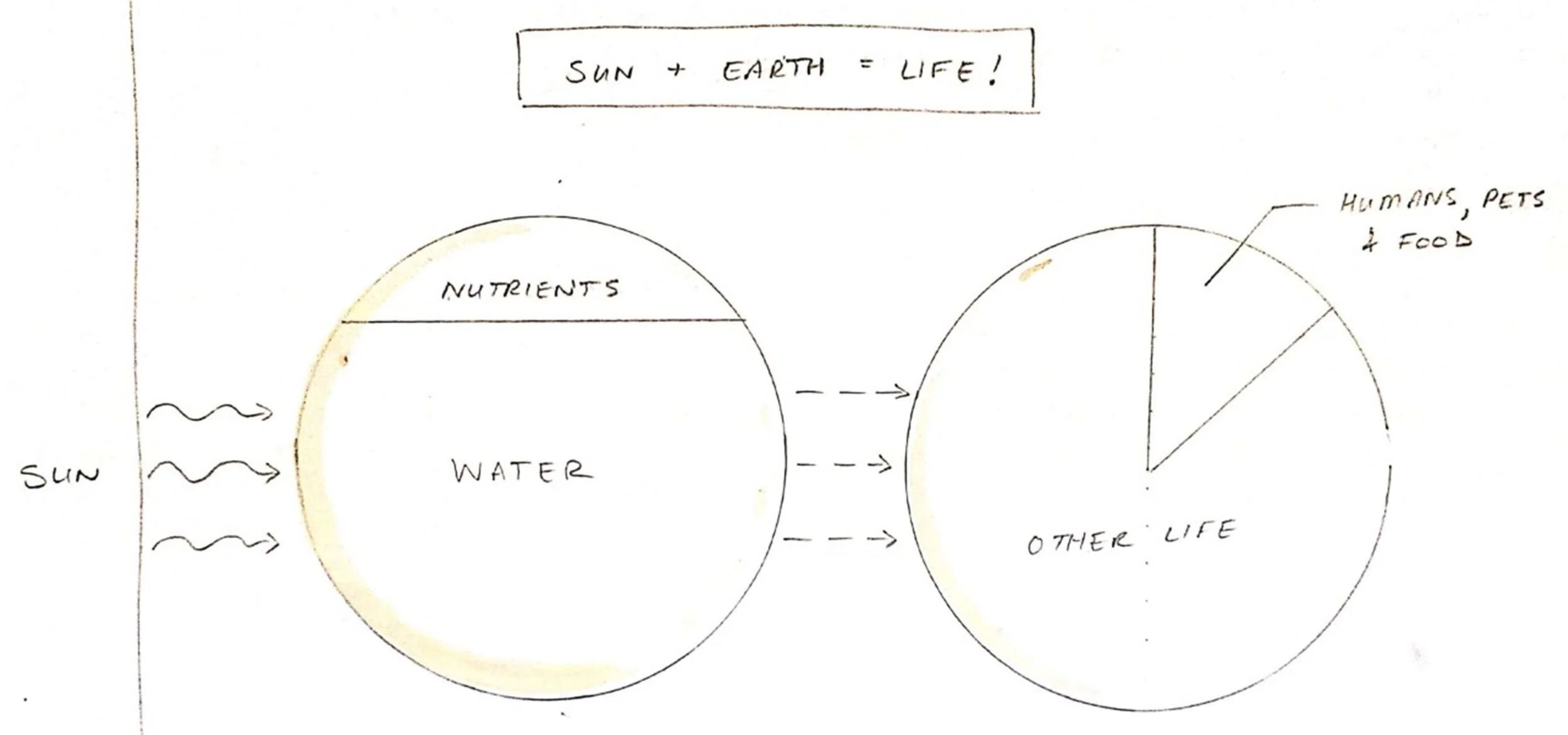
#15: Earth Equation
Traced my coffee cup and sketched a simple 3-step model of how the Earth works:
1. Solar rays hit the Earth
2. Nutrients and water are driven into more complex forms, called Life
3. Humans claim some portion of that Life-giving capacity for themselves
Climate change is just a symptom of Humanity's growing claim on Earth's Life-space.
We can replace fossil fuels - a kind of nutrient - with minerals that aren't yet overexploited. That's how we'll make more solar PV panels, electric vehicles and wind turbines. But ultimately we have to reduce our overall claim on the Earth System's life-giving capacity. -
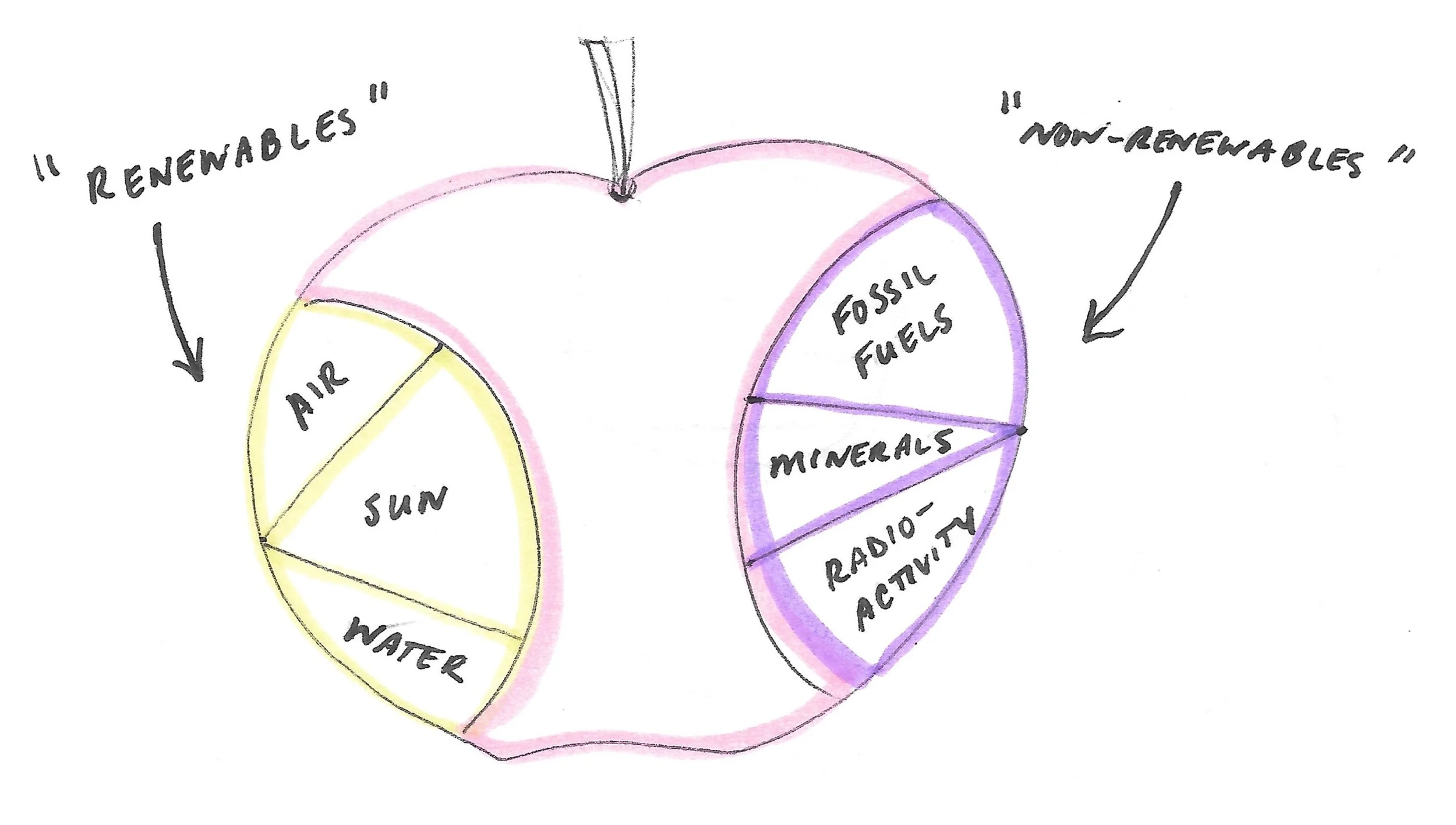
#16: Eat the Earth
The Earth is a finite system no matter how you look at it. And everything we do – refining and wielding energy, collecting and combining materials, pursuing our dreams – all of it requires us to claim some part of that finite system for ourselves.
We tend to think of fossil fuels as “extractive” because they come from a finite pool of resources stored physically in the Earth. But capturing the sun with photovoltaic panels and wind turbines is no less extractive, it’s just that the scale is currently different.
It's possible to eat up the Earth from two different directions. While we scale back one, let’s not go crazy with the other. -
#17: The Jordan Paradox
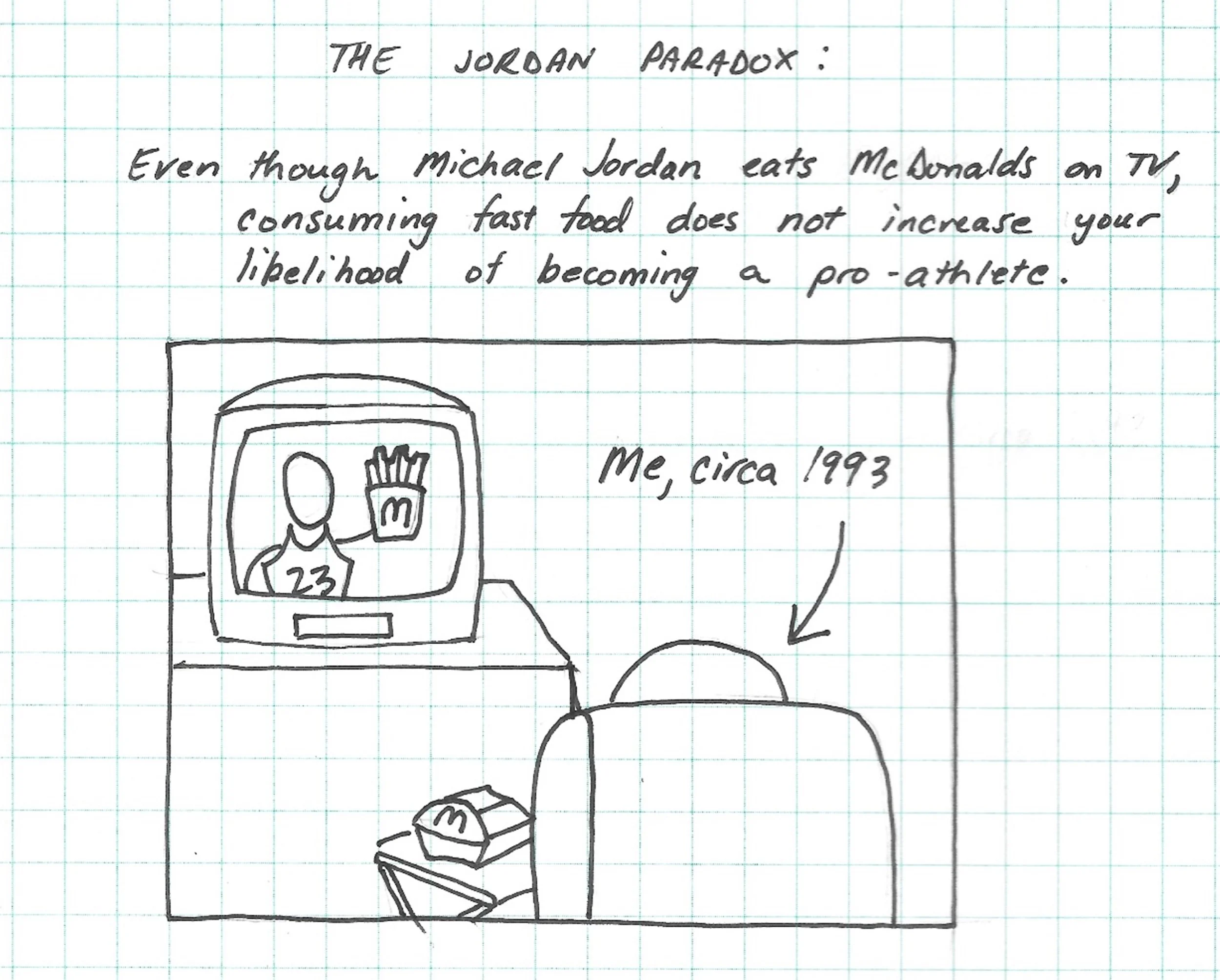
Back in the day, everyone wanted to BE LIKE MIKE. But consuming the products he promoted on TV didn’t turn us all into professional athletes. Not surprising. I sketched the “Jordan Paradox” to illustrate a point about environmental technologies.
Most of us environmental advocates are still acting surprised that technological efficiencies do not deliver meaningful impact reductions. When technology gets more efficient, but overall resource use still rises we call it the “Jevons Paradox.” But this is not paradoxical. A growth society uses efficiency to deliver more products and services to more people, without regard for total environmental impact.
Just like MJ’s commercials, efficiency offers increased sales, but promises nothing for overall performance. -
#18: Watter
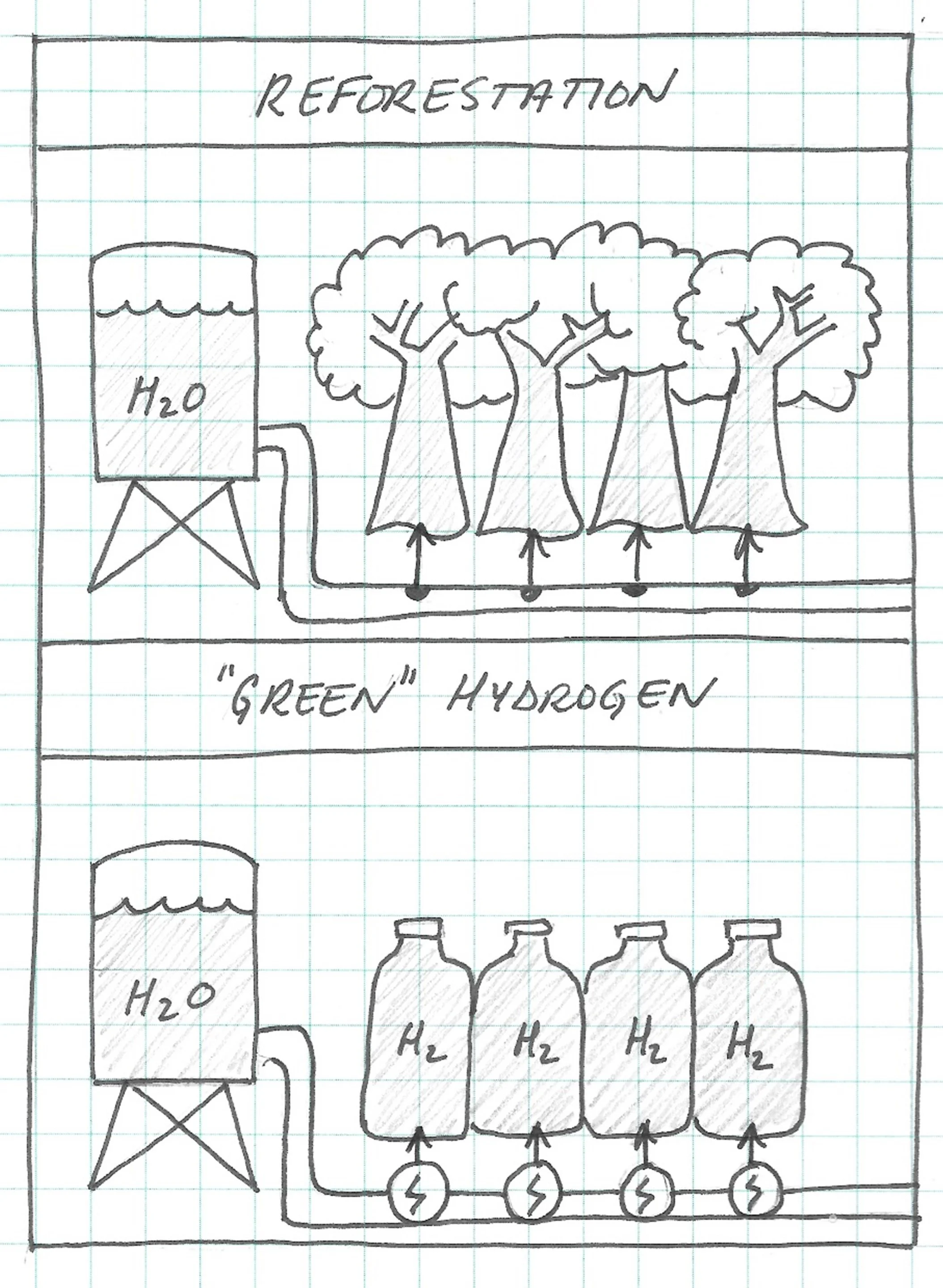
Just a friendly science reminder about the 2nd Law of Thermodynamics: Every action, every activity, is paid for with Earth resources. We often summarize this rule as, "There's no such thing as a free lunch."
Want to scale up tree planting to “soak up” carbon? Want to spread "clean green" hydrogen to offset fossil fuels? Both are going to cost us industrial-scale quantities of WATER.
If we are not discussing limits to overall economic activity, then we are bound to keep eating the Earth as if it was a free lunch. -
#19: Strong Sustainability
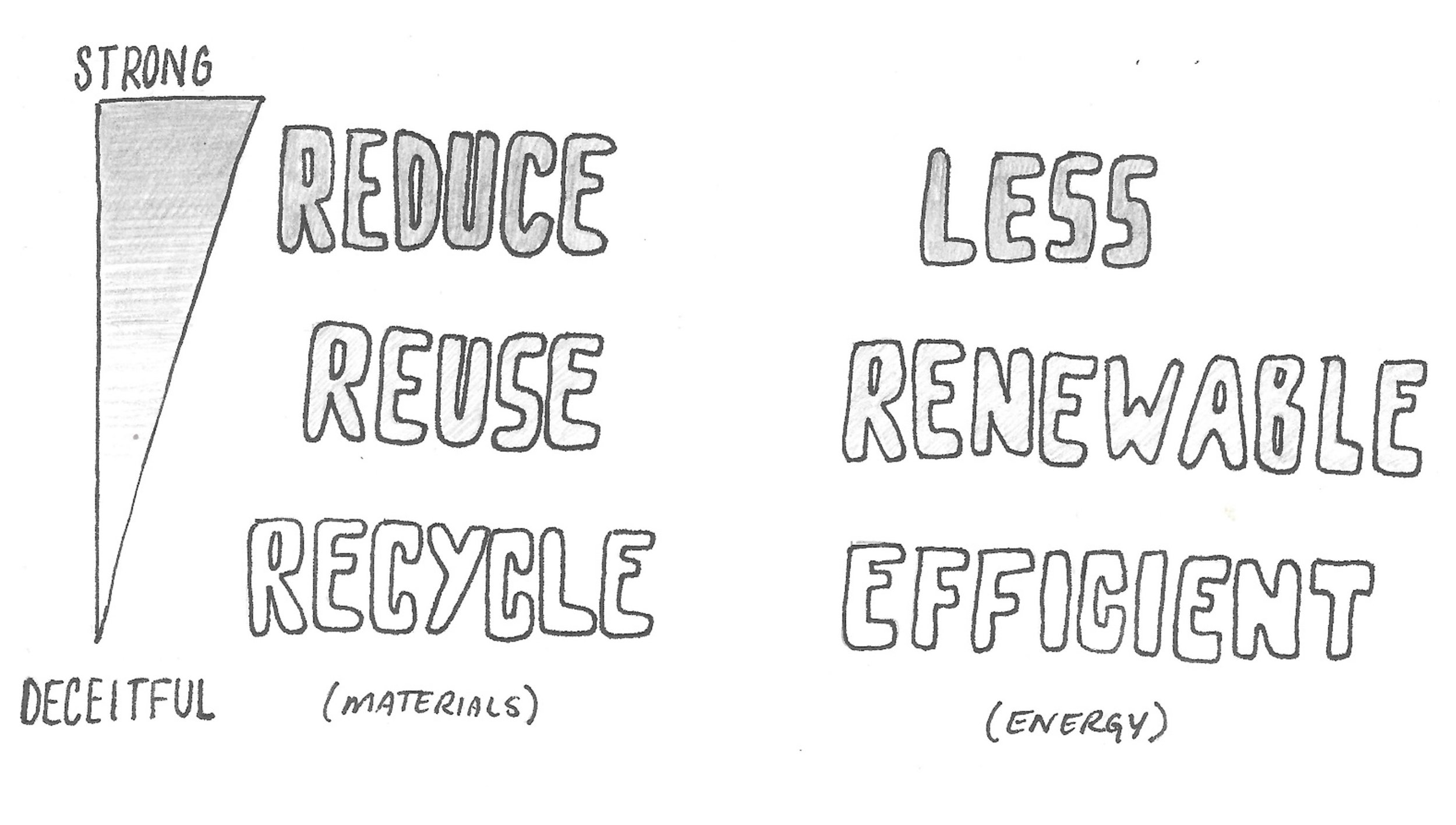
REDUCE, REUSE, RECYCLE. It's a list of priorities for handling materials in an environmental way. But if we're thinking globally, and considering limits to expanding economic activity, then RECYCLING is simply a tool for greasing the wheels of growth, and REUSE is another word for repair and maintenance, i.e. good business sense. The only concept in the list that communicates a strong sense of the limits we face is REDUCE.
I see a similar trio forming in the energy space (see below). The call must be for LESS energy demand. EFFICIENCY is just as deceitful as RECYCLING, and RENEWABLE is as business-as-usual as REUSE. -
#20: Bad for the Environment
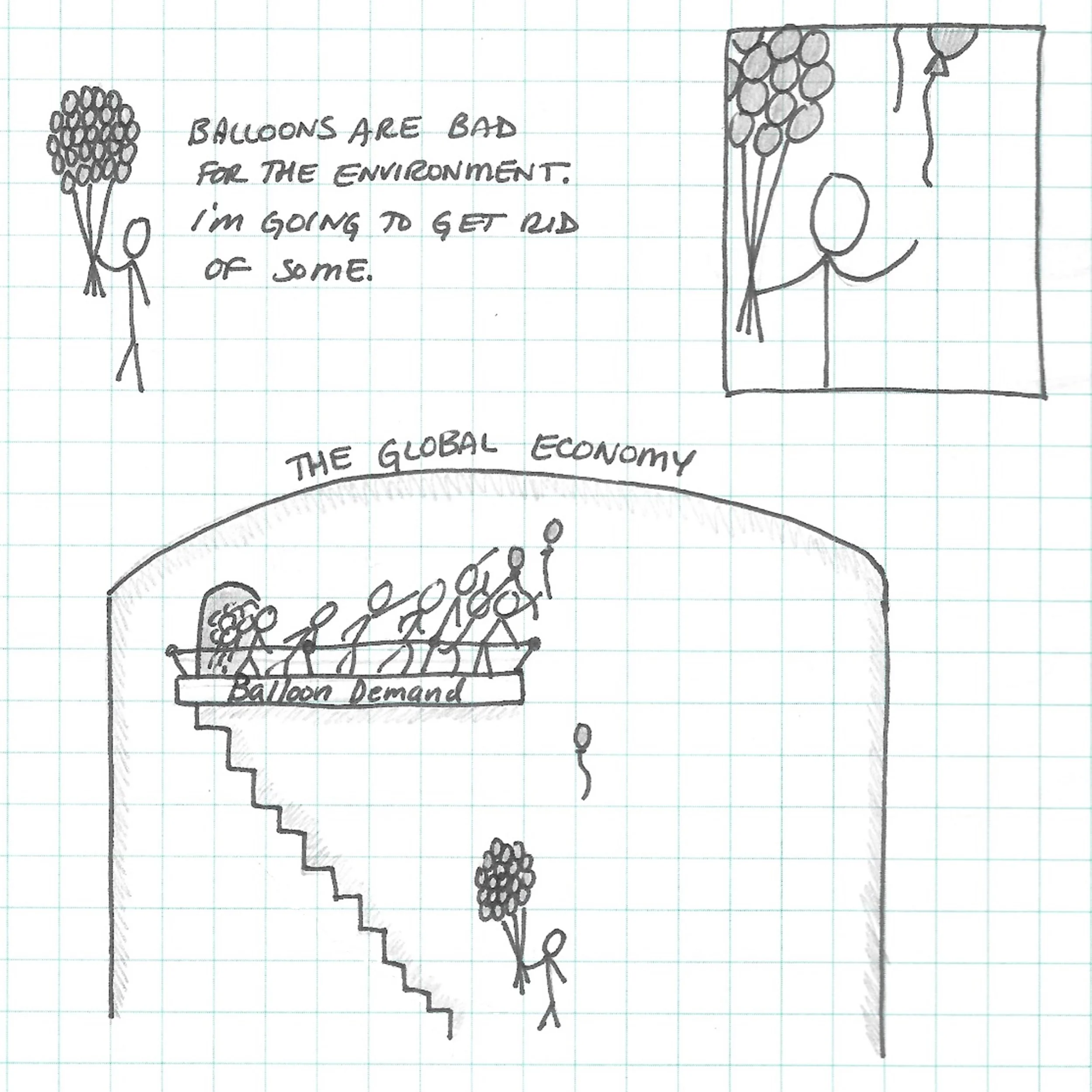
When we "reduce" or do "less" in one place, the resources we refuse are freed up for consumption by those who would love to have more. Many deserve some degree of "more", many do not.
How shall we convene our global society so that some balloons are shared while others are released completely?
This is a more important question than what the balloons are made of... -
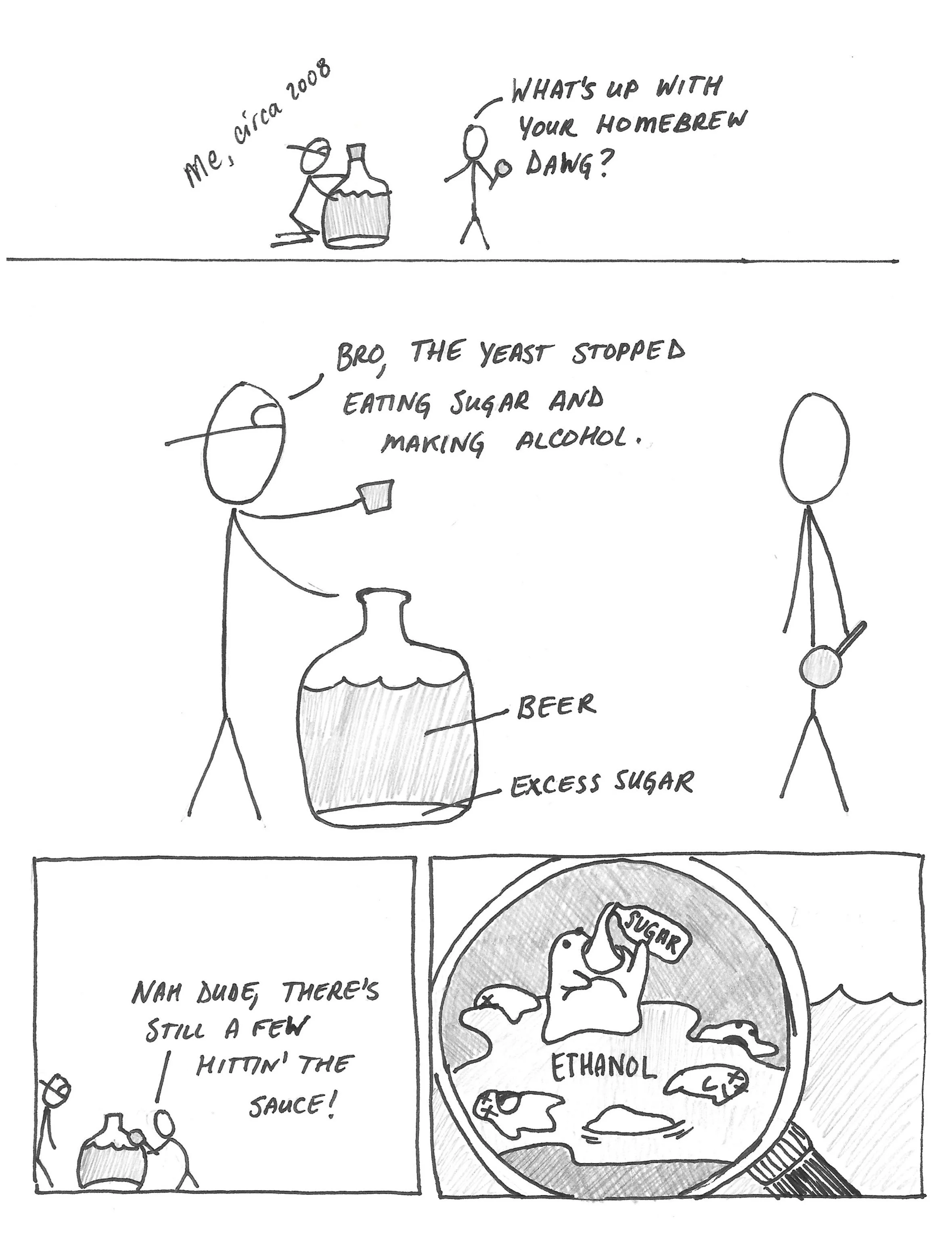
#21: Homebrew
Making the planet uninhabitable is different from "running out of resources."
When yeast in a batch of beer die off, it's because they've been poisoned by their own waste product - ethanol - not because they run out of sugar to eat. Any homebrewer learns this pretty quickly. I know! In my frat bro years I tried to make a super-alcoholic beer by dumping a bunch of sugar into my first brew attempt. Epic fail illustrated here.
Two takeaways:
1) Environmental sustainability is about limiting our resource use to avoid poisoning our surroundings. It is NOT about supply concerns. There are many peak oil and mineral supply conversations masquerading as sustainability conversations. Don't get it twisted. We will poison ourselves with the byproducts of our resource use far before we can run out of them.
This is one way to think about climate change (a mass poisoning event) and fossil fuels (an abundant resource that we can always dig further and deeper for).
2) Catastrophe does not happen immediately or equitably. As ethanol in the brew rises, there is a steady "death phase" during which a gradually smaller and smaller population of yeast gets to continue eating sugar. These privileged yeasts actually enjoy cheaper resource access as the competition dies off. Yeast cells cannot collectively decide to avoid this outcome. Every good batch of beer or wine goes through this biochemical process in a very predictable way.
But we humans are not yeast cells and the Earth is not a big beverage reserved for our consumption. Let's stop treating it like one. -
#22: Congratulations
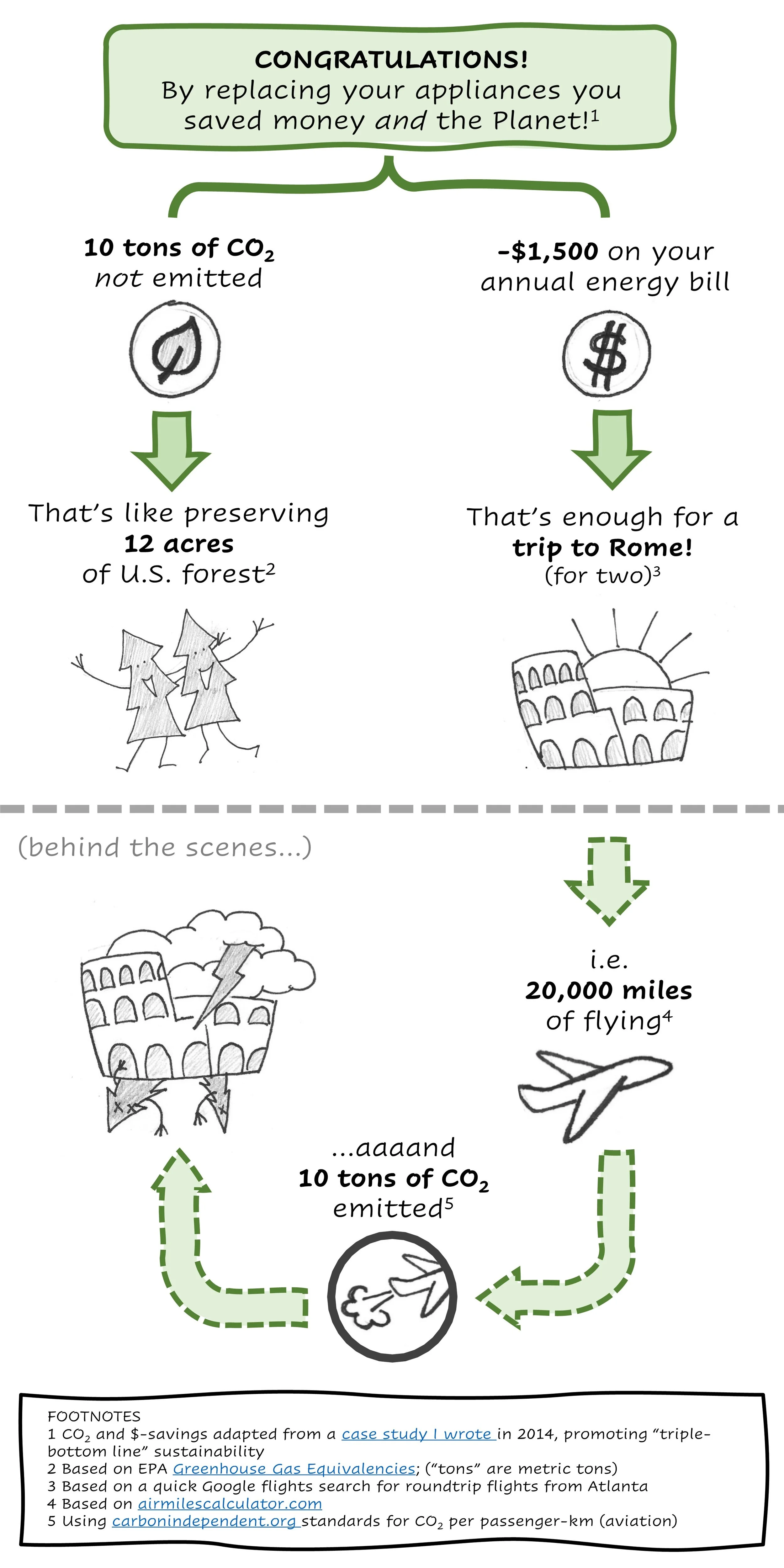
As an environmental consultant, I used to write "triple bottom line" case studies for businesses, showing how they were saving resources, reducing pollution, and boosting the economy. I now see that these case studies weren't telling the whole environmental story, so I've updated one of them here.
The real win-win requires us to permanently reduce emissions. That means that the cost savings of reducing waste or being more efficient must NOT be re-invested in economic growth, otherwise the emissions simply come out in a different sector of the economy.
That's the only way we'll actually reduce environmental impacts and keep the planet a habitable place to live and thrive. We don't need triple bottom-line accounting. We need a just and equitable degrowth. -
#23: Regenerative
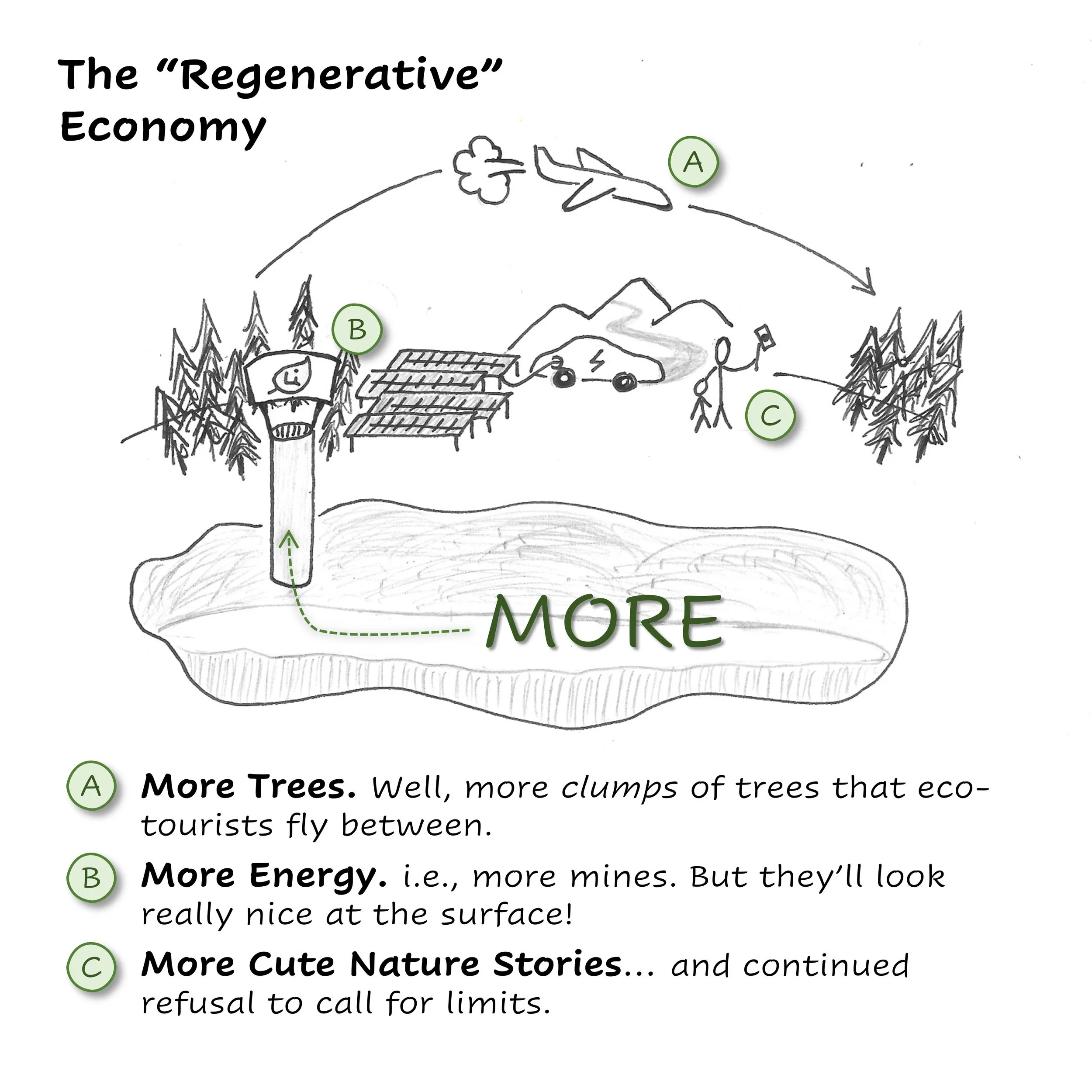
I made this one while I was reading Paul Hawken's latest book “Regeneration.” It was a nice compendium of ecological information, but it did not discuss the very difficult topic of limits to growth as an integral part of ecological healing and rebuilding. It’s mostly full of anecdotes about regenerative practices such as a rewilding experiment near London that has become a profitable ecotourism attraction, and the same bucolic pastures and fields of solar panels we’ve been hearing about for decades.
What we need is a call for global LIMITS on extractive activity, not anecdotes promising MORE of everything.
Or is "regeneration" just another plundering activity?
More trees, at the cost of less Earth. -
#24: Extractive
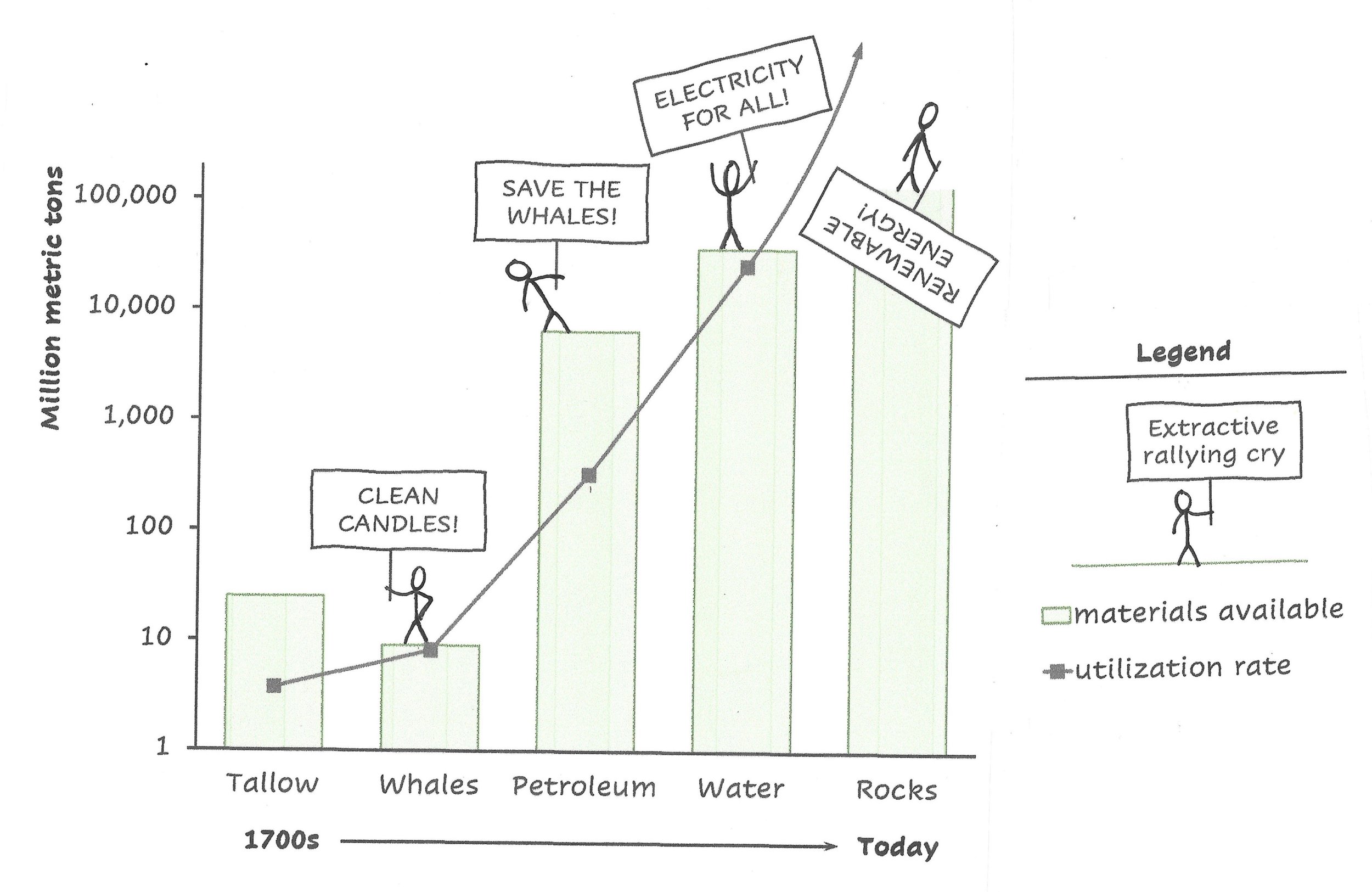
For centuries human societies have been programming new ways to claim the Earth for ourselves. As we do, we find some hot-button issue to rally around - a kind of distraction from the next phase of extraction.
🐋WHALE oil was a clean-burning alternative to animal fat (i.e., tallow) candles. That was a good excuse to go hunt them to the brink of extinction.
⚫PETROLEUM advocates tried to claim they were saving the whales as the industry boomed in the late 1800s. We subsequently dumped all that carbon in the ocean - the whales' one and only home.
💧WATER was next. The damming of most major rivers in the US was justified by rural electrification and nuclear research projects; part of the New Deal and World War II efforts.
🪨And now all we have left to exploit are the ROCKS. Not as easy as the other stuff to extract and transform, but we will have them too! ... under the banner of clean and renewable energy. -
#25: Blobs
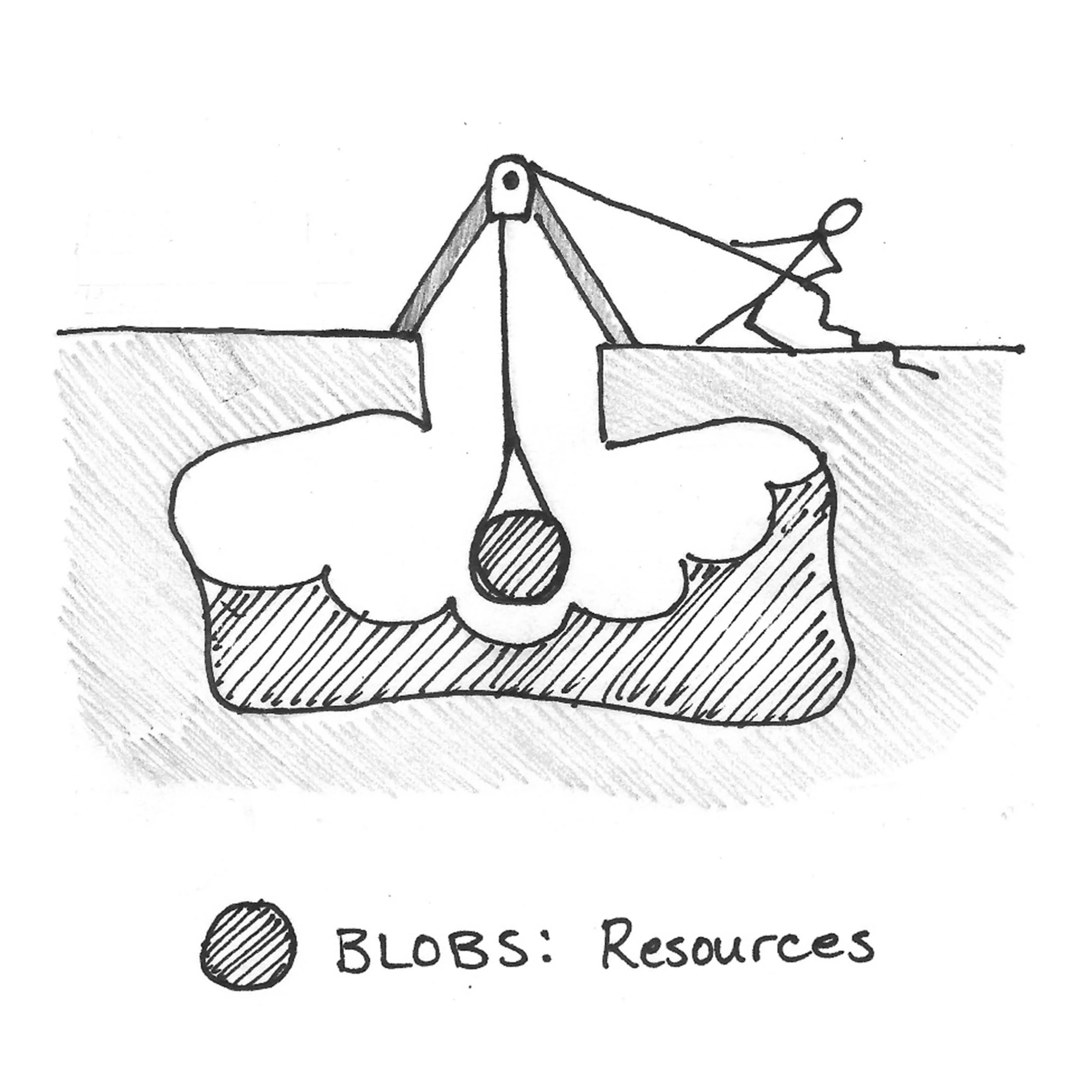
New, more efficient technologies will not prevent humanity from overwhelming our one, shared, habitat - the Earth. That's why we need global limits on extraction and the services we demand from the Earth System.
Why is efficiency a flawed strategy, and what is "extraction" anyway? Here is sketch #1 of 9 that will help us wrap our brains around the answer.
The BLOB being hoisted up represents the resources and ecological functions that we extract and convert into our products and services.
- the underground cavern is the EARTH
- the stick-human, pulley and rope system is the EXTRACTION activity that delivers wants and needs to society"
BLOBS are the raw materials/resources we take from the Earth System. That includes materials, fuels, air, space, even sunlight! -
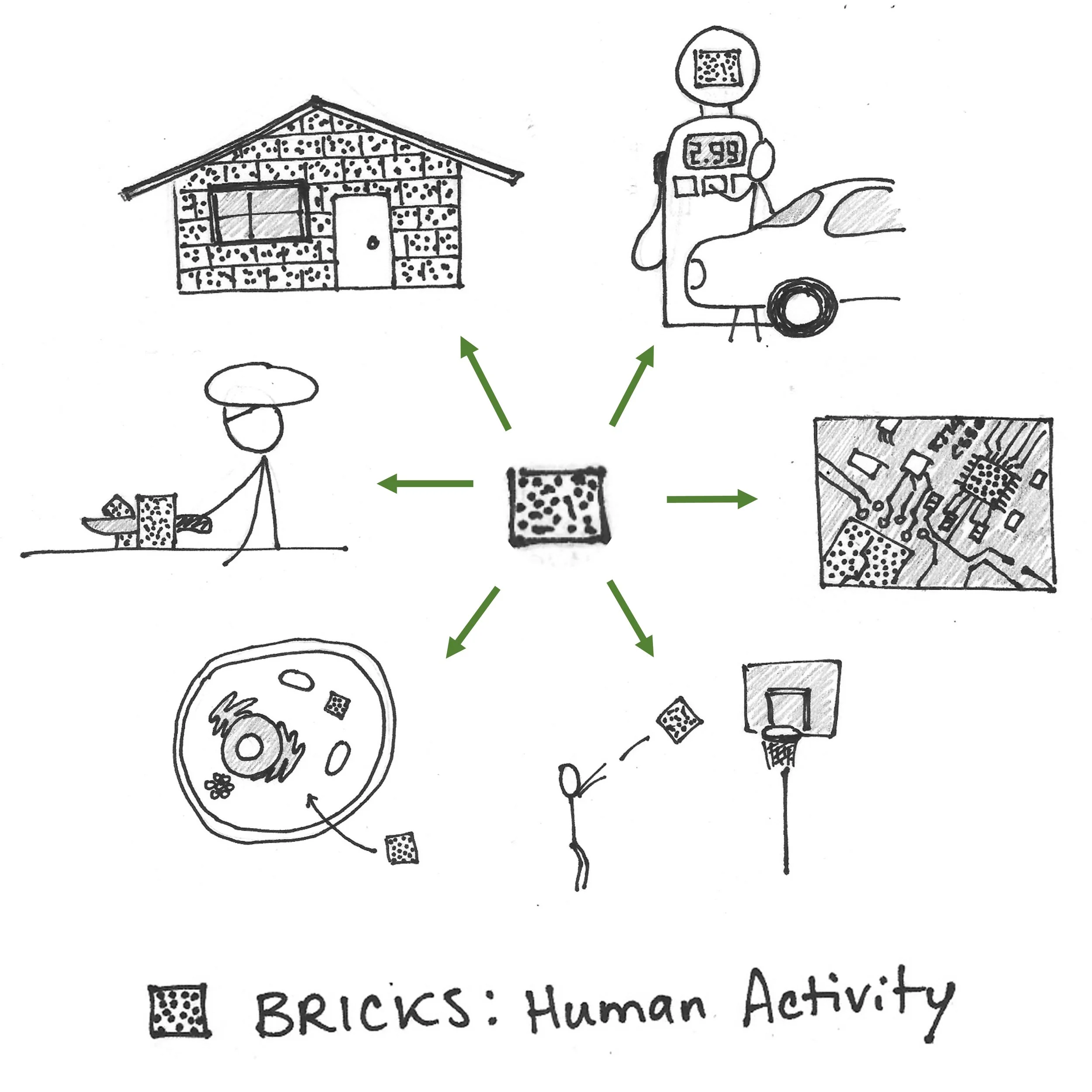
#26: Bricks
BRICKS represent everything we do and use. They're like a generalized unit of human activity.
-
#27: Brick Factory
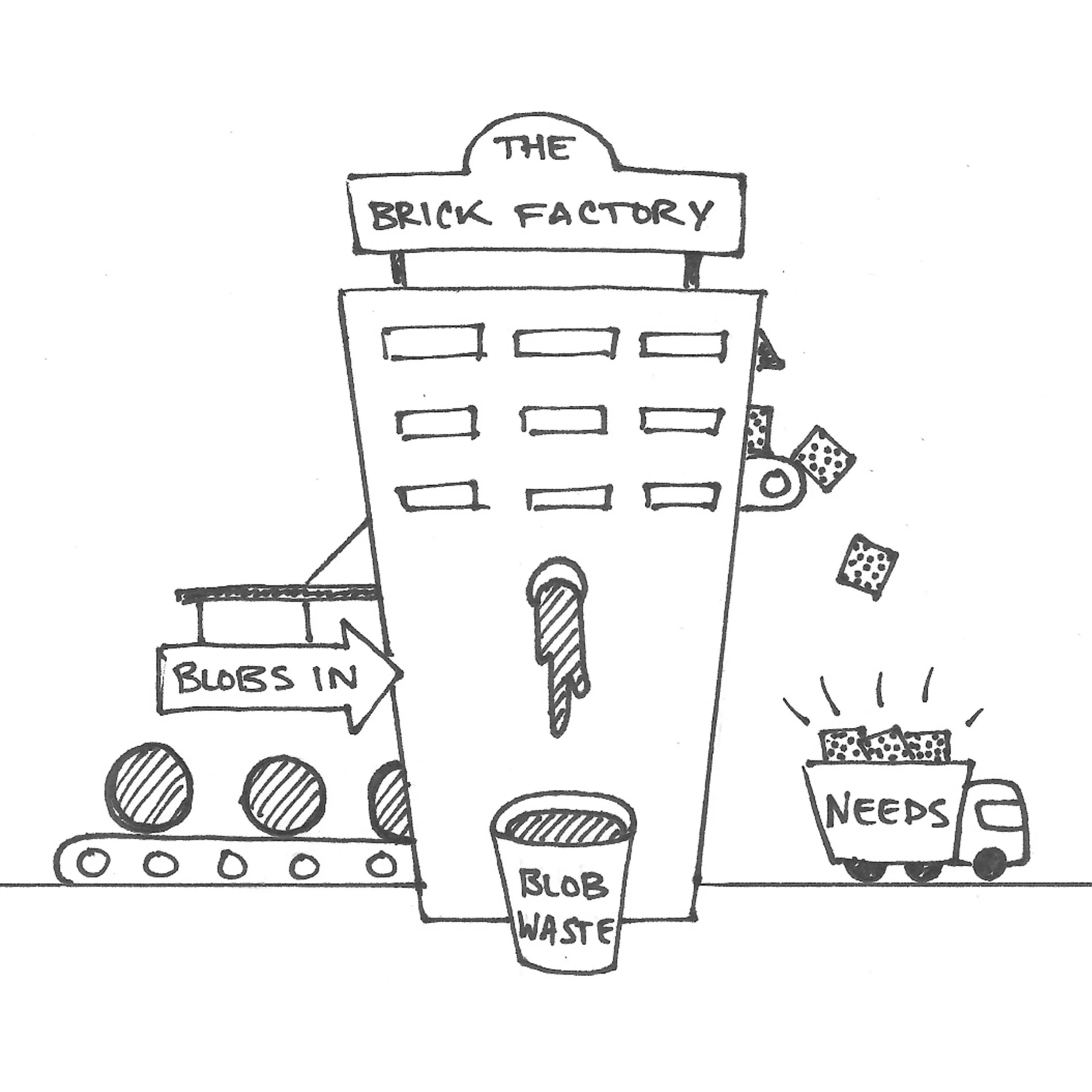
Humans take BLOBS from the Earth and turn them into BRICKS.
And blobs don't become bricks on their own. We have to apply technological and economic tools to provide the goods and services (i.e., bricks) on which we rely. -
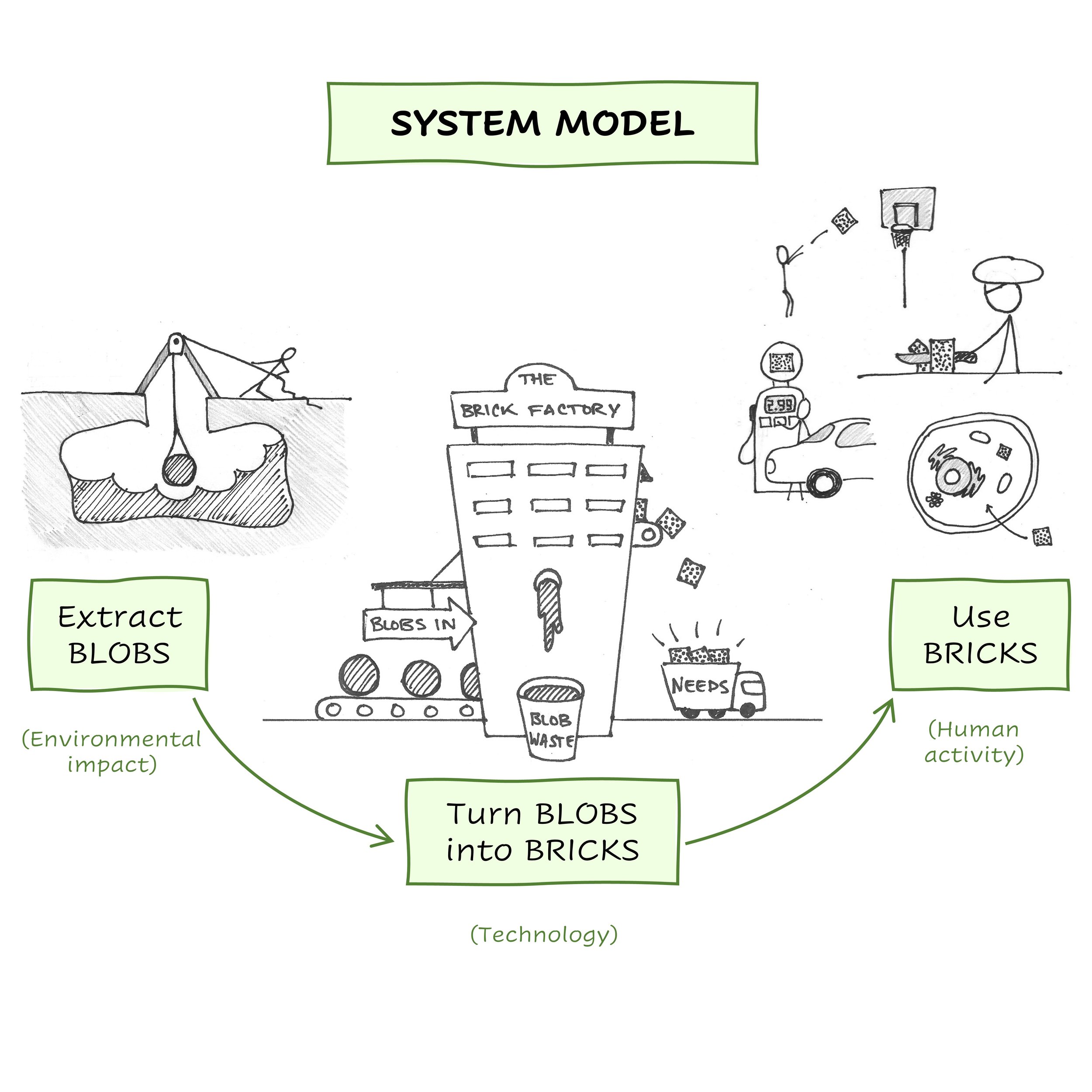
#28: Blob Model Summary
Understanding efficiency, with blobs and bricks, part 4. Here's a summary so far.
-
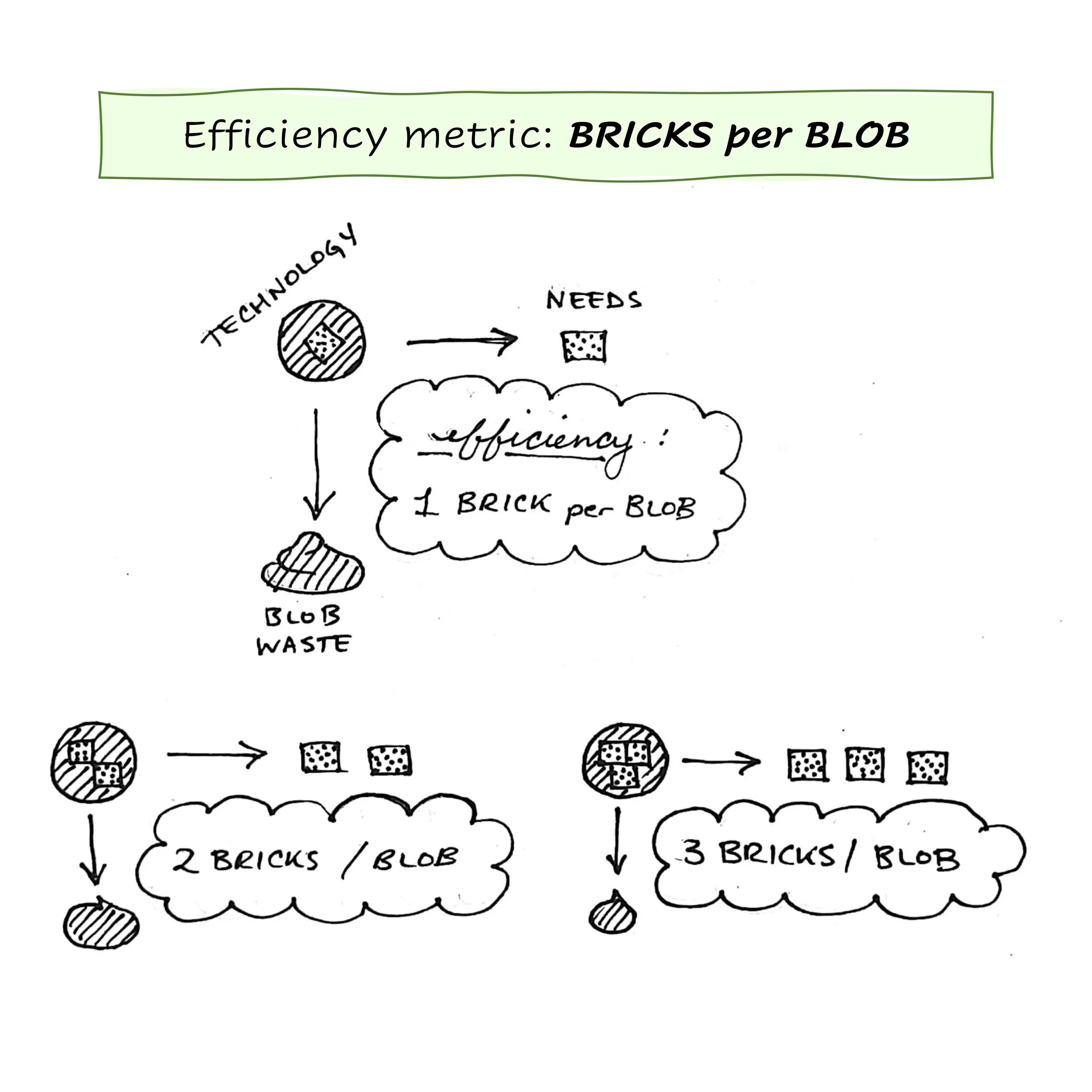
#29: Bricks per Blob
Think efficiency can reduce climate change and save the planet? Not without limits on extraction and awareness about how efficiency drives economic growth.
The key efficiency metric in this model system is BRICKS PER BLOB. -
#30: Sustainability Problem
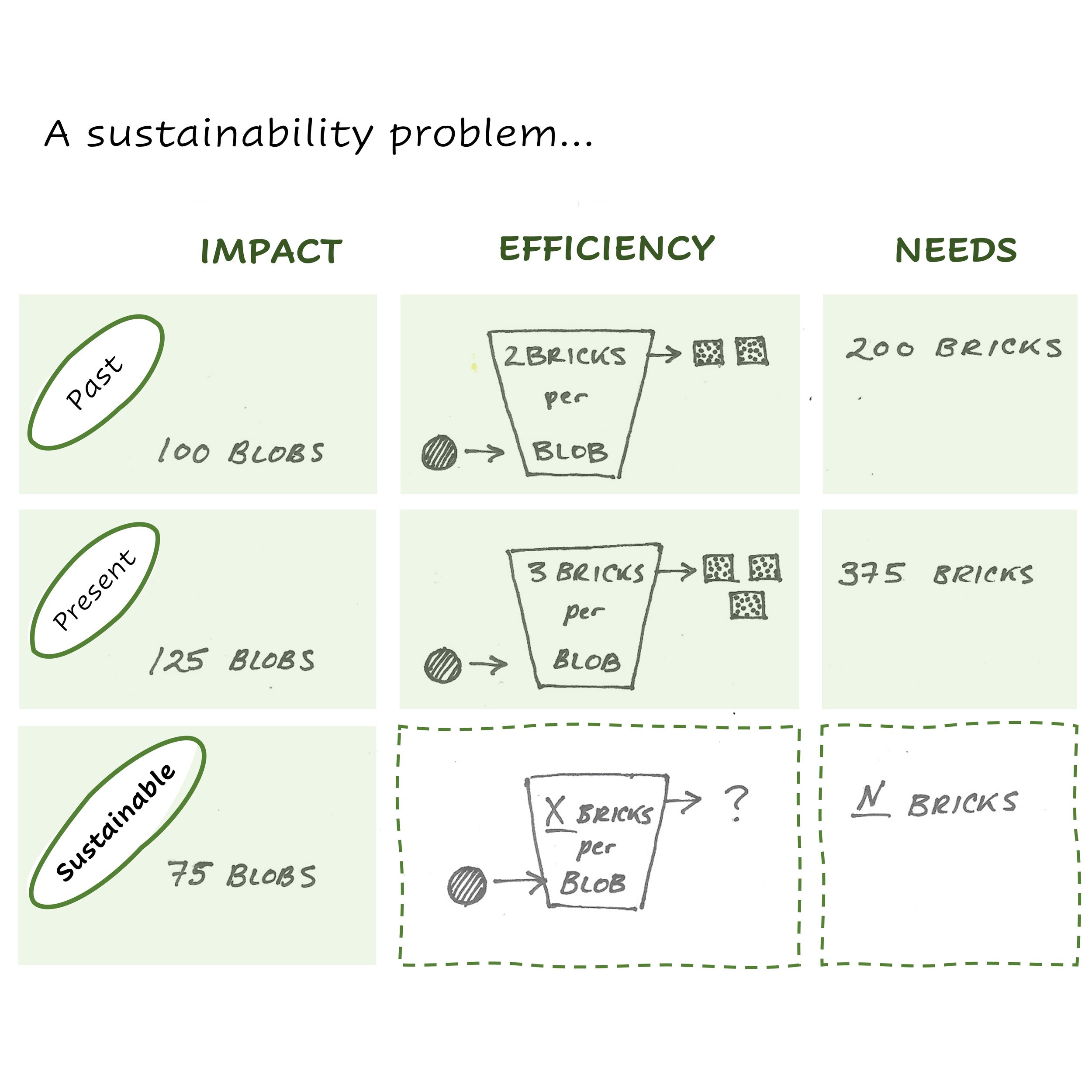
Now that we have a model of how the Earth works, we can draw up some scenarios representing our modern sustainability conundrum:
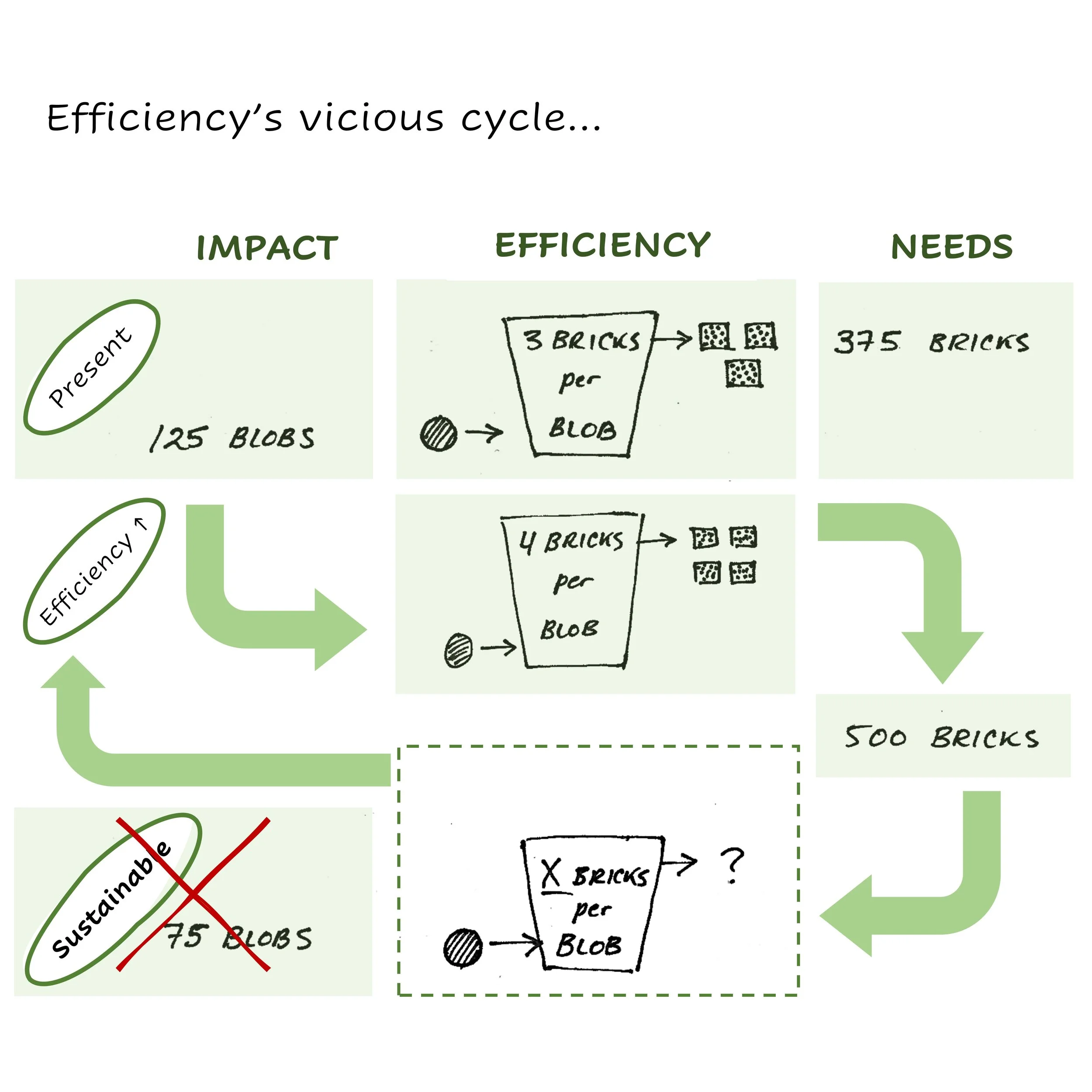
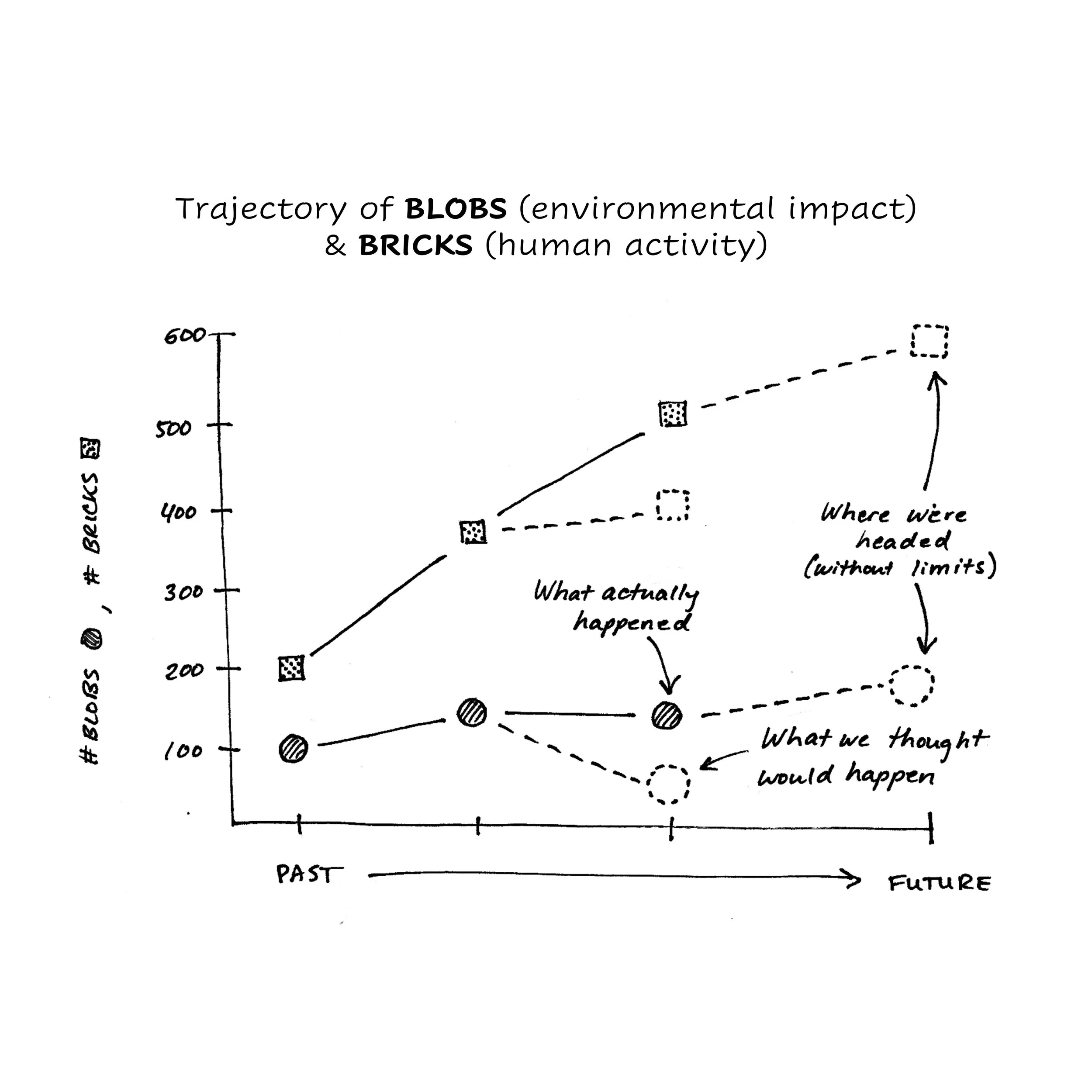
In the PAST, let's say humanity demanded 100 BLOBS from the Earth and converted those to goods and services with an efficiency of 2 BRICKS PER BLOB. Human activity overall amounted to 100 BLOBS x 2 Br/Bl = 200 BRICKS.
In the PRESENT, humanity is now more efficient than it was, we're at 3 BRICKS PER BLOB! We've also opened up more of the Earth to extraction, and we're now taking 125 BLOBS from it. 125 BLOBS x 3 Br/Bl = 375 BRICKS worth of human activity.
Achieving SUSTAINABILITY requires us to reduce our impact, let's say to 75 BLOBS. From here, there's two variables we can work with to get there: BRICKS PER BLOB and overall human activity (# BRICKS). -
#31: Efficiency
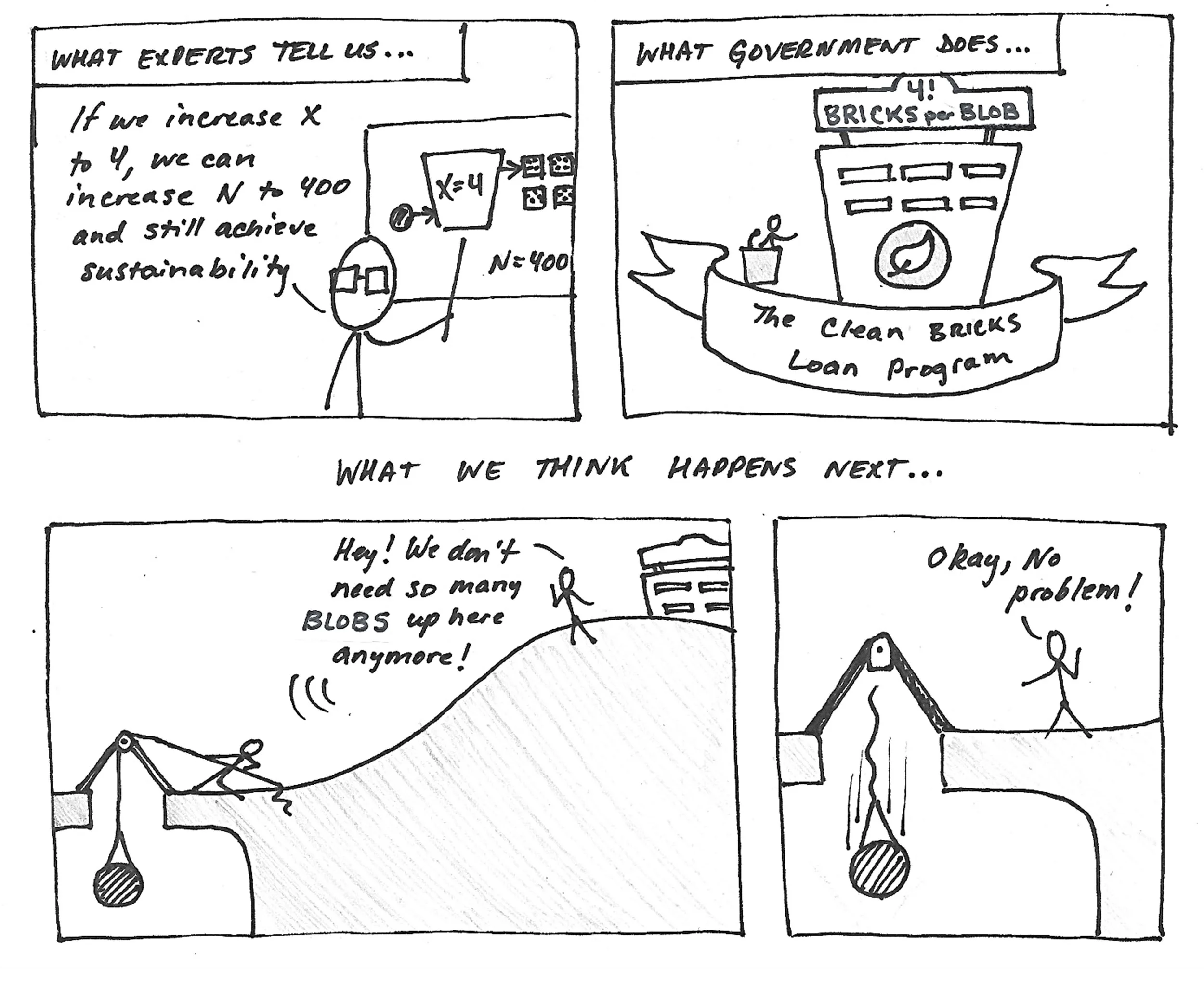
Business, government, climate experts, and even activists have been pursuing efficiency as an environmental strategy. But efficiency is a growth strategy! It's just that the technologies and policy initiatives are so heavily dressed in green that we THINK there's impact reduction happening somewhere in the supply chain. That assumption is dangerously wrong.
Here's what we imagine is happening when we implement more efficient energy/production systems...
(see next post for what actually happens) -
#32: What Actually Happens
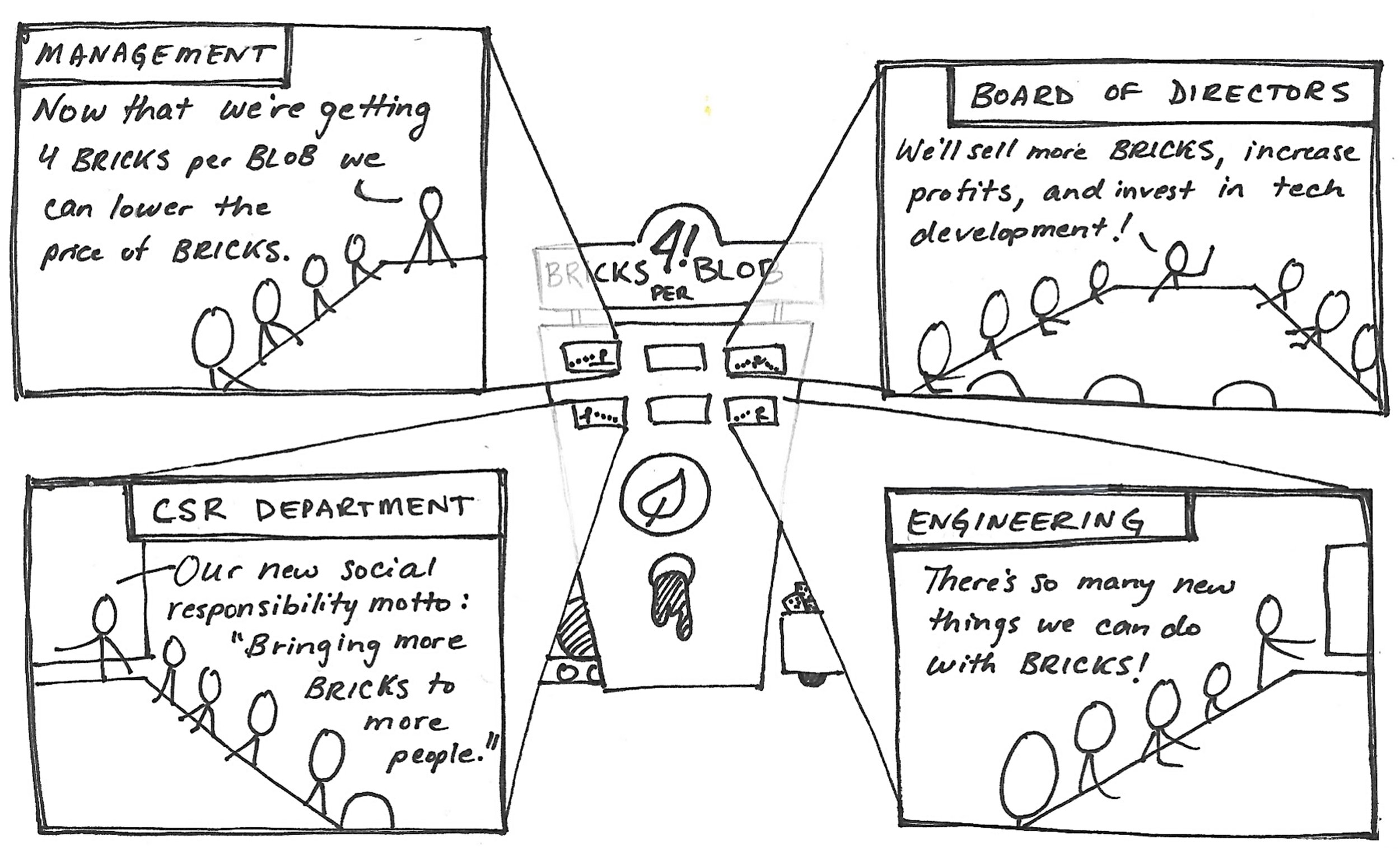
Efficiency measures free up productive capacity and every department is eager to get in on that new freedom. Profits, new products, new sustainability slogans…
Without a limit on extraction, the productivity and waste-reduction achievements of efficiency are eaten up in all sorts of other ways. "Growth" is just a shorthand way of describing all of the enticing outcomes of efficiency; all of them EXCEPT for environmental impact reduction. -
#33a: Limitless Efficiency's Vicious Cycle
In the past nine sketches I have presented a thought experiment on efficiency. My goal is to point out the glaringly dangerous assumption that efficiency delivers environmental impact reduction.
This is a false assumption. But that’s only obvious if you take the time to step away from the piles of sustainability information we are used to consuming. Listen to any environmental podcast, read any corporate sustainability report, dig into countries’ Nationally Determined Contributions (NDCs) to reducing climate change, skim any academic paper on global sustainability… you are guaranteed to encounter efficiency as the prime strategy for reducing environmental impacts. And you will read very little about placing overall limits on extraction and use of our one Earth’s energy and materials.
I sketched this out in stick figures and cartoony font specifically so that we step away from the usual glossy reports and grasp the very fundamental way that efficiency operates in our modern economy.
Efficiency without limits is unsustainable. -
#33b: Limitless Efficiency's Vicious Cycle
In the past nine sketches I have presented a thought experiment on efficiency. My goal is to point out the glaringly dangerous assumption that efficiency delivers environmental impact reduction.
This is a false assumption. But that’s only obvious if you take the time to step away from the piles of sustainability information we are used to consuming. Listen to any environmental podcast, read any corporate sustainability report, dig into countries’ Nationally Determined Contributions (NDCs) to reducing climate change, skim any academic paper on global sustainability… you are guaranteed to encounter efficiency as the prime strategy for reducing environmental impacts. And you will read very little about placing overall limits on extraction and use of our one Earth’s energy and materials.
I sketched this out in stick figures and cartoony font specifically so that we step away from the usual glossy reports and grasp the very fundamental way that efficiency operates in our modern economy.
Efficiency without limits is unsustainable. -
#34: Growth Wedges
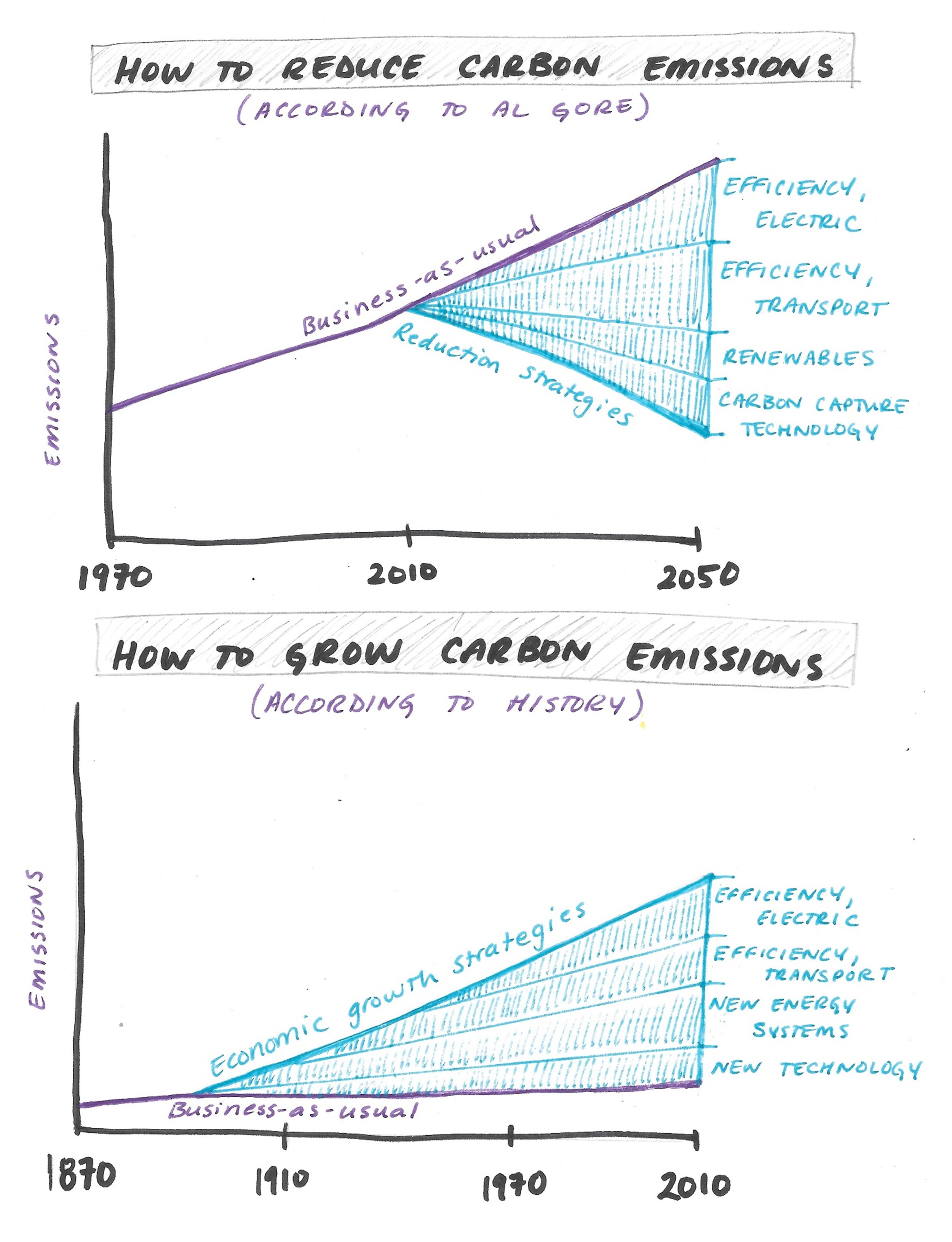
TLDR: Many leading voices of the climate movement have taken a set of key economic and emissions-growth strategies and re-labeled them as emissions reduction strategies. As long as this re-labeling prevails, humanity will not be able to rein in emissions, let alone our outsized ecological footprint.
DETAIL: Fifteen years ago, Al Gore released An Inconvenient Truth, the hit documentary that raised the alarm about climate change to the general public. There's a scene towards the end where Vice President Gore shows the graph that I've sketched here (top).
It shows emissions reduction strategies as "wedges" that can nudge emissions downward from their business-as-usual trajectory. The reduction strategies are basically: Energy Efficiency, Renewable Energy, and Carbon Capture (see link to actual scene from Inconvenient Truth to compare; in comments). This "wedge" model of emissions reduction was popular back in the day. Read the IPCC's 2007 Assessment Report and you will find wedges all over the place. No one calls them wedges anymore, but the concept lives on strong in the country-level reduction commitments that were set at COP26 in Glasgow.
Now, let's take a look at a slightly extended history (bottom graph) to check the validity of the wedge model. Here are some factors (as wedges) driving the explosion of carbon emissions starting in the mid-1900s: New energy conversion systems enabled fossil fuels to be tapped for new applications; then efficiency breakthroughs in transportation and electricity allowed for large-scale uptake of cars, freight, home electricity, and electricity-based industrial processes. History, then, shows us that what leading climate voices have labeled "emissions reduction" strategies are actually economic growth strategies.
Improving efficiency without enforcing limits is a sure way to miss hitting absolute emissions reduction targets, and an even surer way to mislead people. -
#35: The Cloud
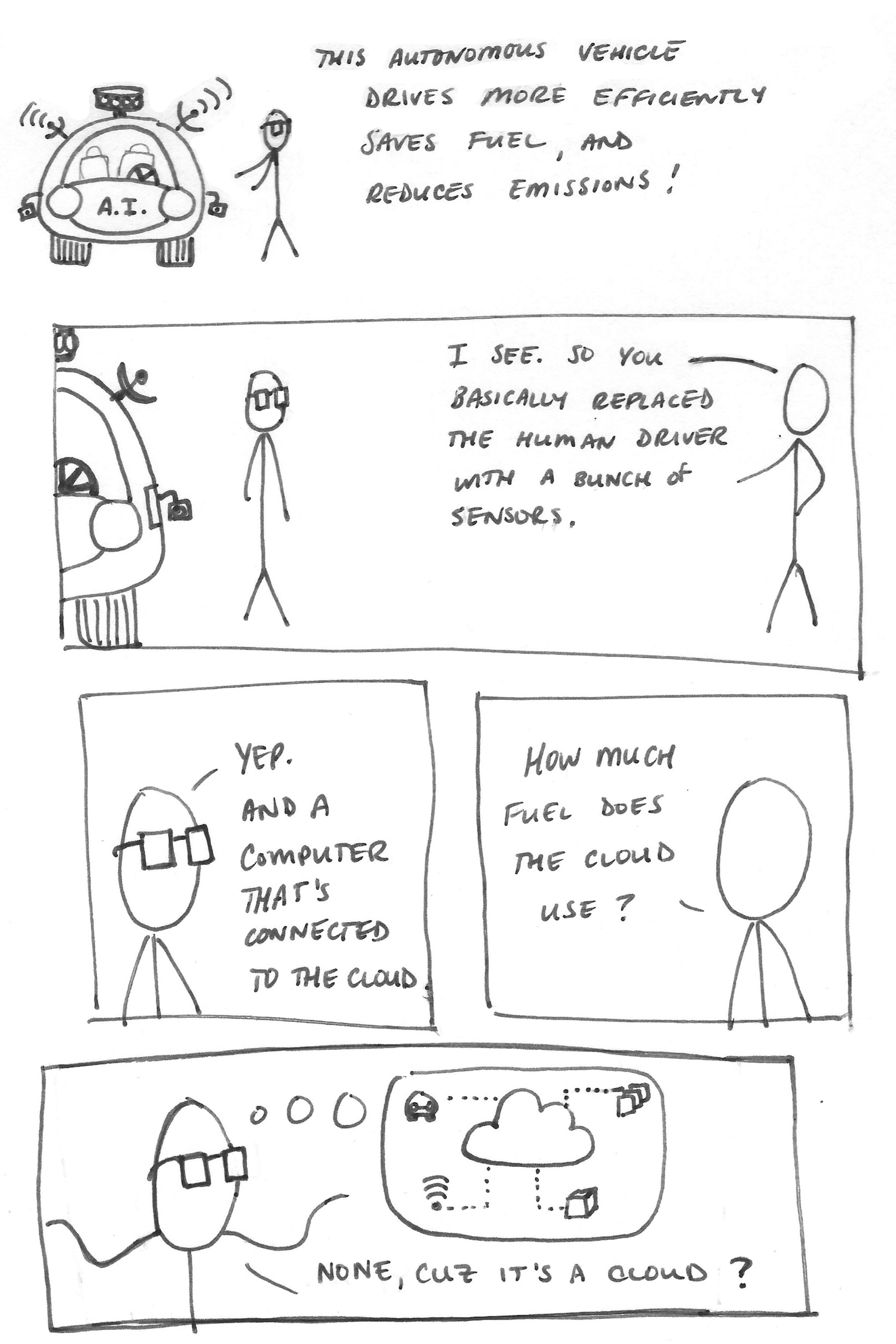
This episode is inspired by research we published a few months ago @ https://iopscience.iop.org/article/10.1088/1748-9326/ac413b
60% of the 115 environmental impact articles we reviewed did NOT consider the impacts of network infrastructure (i.e., the internet, data transmission, servers, and all the material and energy use contained therein). That's a pretty big system boundary gap, considering how connected and internet-reliant most "smart" and "sustainable" techno-solutions tend to be. Research in the sustainable transportation sector ignores its cyber-physical nature. Perhaps it doesn't help that we've all been sold on the image of data transmission and storage as a "cloud." -
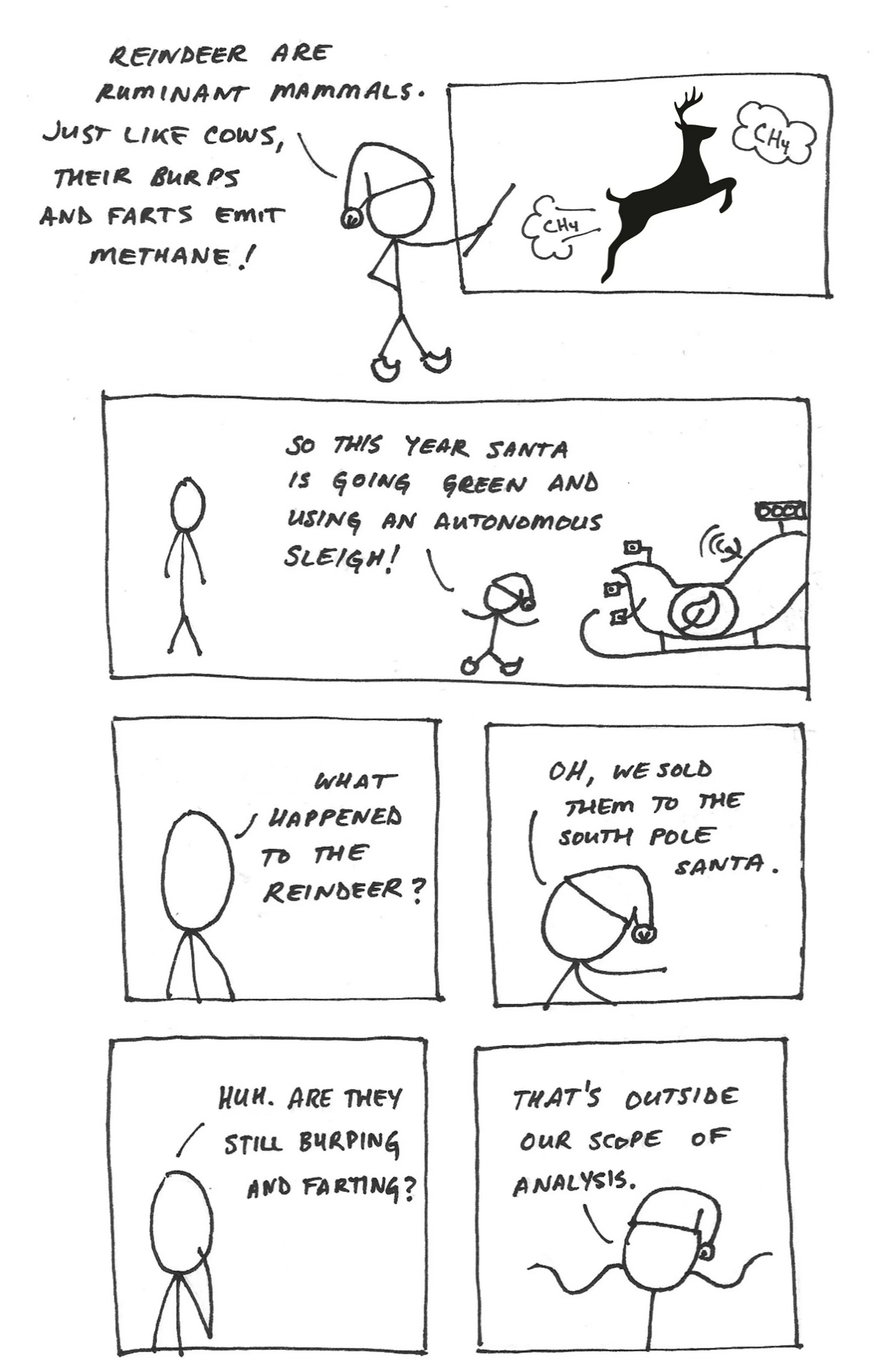
#36: Reindeer Farts
Another takeaway from our literature review published in Environmental Research Letters.
57% of the 115 environmental impact articles we reviewed did NOT consider economic feedbacks within their scope of analysis. That means they ignored the effects of behavior change, rebound effects (i.e., the Jevons paradox) and economic growth due to efficiency gain, among many possible feedback mechanisms.
Most "smart" and "sustainable" techno-solutions base their environmental claims on efficiency metrics at the product level. Independent environmental research must strive for a broader Earth System-level boundary of analysis!
I first drew/posted this in December 2021, hence the holiday-themed sketch (: -
#37-46: Self-Portrait
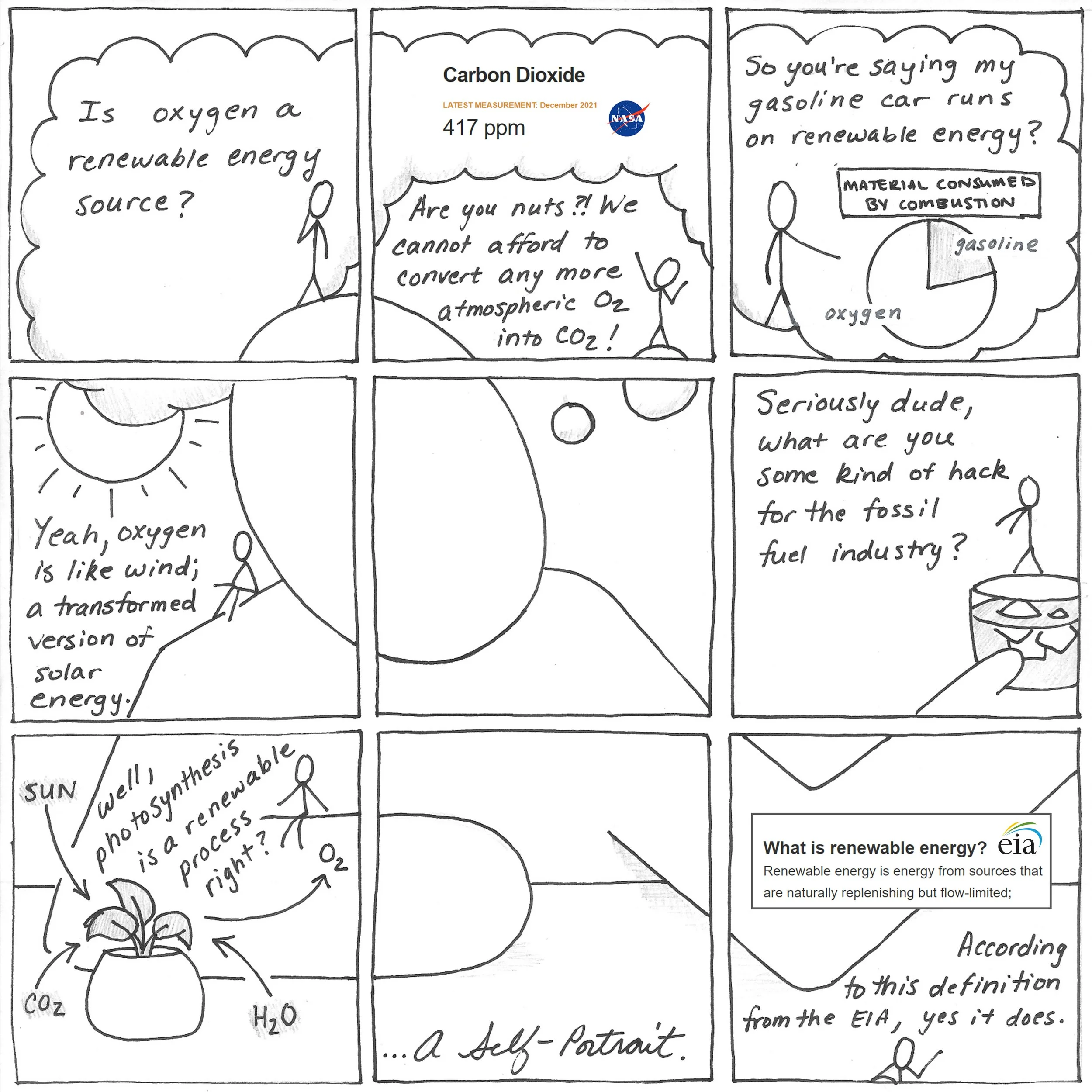
Is Oxygen a Renewable Energy Source?
This comic strip is a reflection on reflecting on "renewable energy" - why the concept is flawed, why that's a difficult concept to grapple with, and why I need a drink when grappling with it.
Oxygen makes up ~3/4 of the material consumed in a combustion engine. Soooo, could we say that a gasoline-powered car is renewably powered?
This question may sound evil - am I twisting science in support of fossil fuels?So far in this internal dialogue we established that oxygen is a renewable material; that it is the majority material that makes your fossil fueled car run; and that means your car runs at least partially on a renewable energy "source."
The Earth's primary source of renewable energy is radiation from the sun. Almost everything else we call "renewable" is driven by application of that radiation: temperature gradients which drive wind, evapotranspiration lifting water to high ground, valence electrons nudged out of place to generate an electric current, biomass created via photosynthesis. Is free oxygen like this? We wouldn't have (much) free oxygen without photosynthesis...
We can all agree photosynthesis is a renewable process. It's why we consider biofuels to be a renewable fuel. So, is oxygen - synthesized in the same process - also a renewable product?
Oxygen is abundant, yes. But we also need that oxygen to remain O2. When we convert enough of it to CO2 we get a climate change disaster...
-

#47: Algebra
I've sketched out a very fundamental example of how efficiency begets growth - one of millions contained in our collective past. This is the development of algebra, a subject in which many breakthroughs were achieved over a century ago, in the Middle East. Those societies took up a 10-digit numeral system developed in Southeast Asia and used it toward achieving more precise astronomical, geographic, and geometrical calculations. This Hindu-Arabic numeral system was far more efficient than numeral systems prevalent in, for example, Rome.
Let's go to the year 847 C.E. when the Persian mathematician, Kharazmi, was working out the quadratic formula. Writing out that year in roman numerals would be DCCCXLVII, 9 digits. Writing the same year with our modern numeral system (based on the one Kharazmi used) is just 3 digits. That's just one example of the efficiency gains brought on by this numerical technology.
CONCLUSION: The pursuit of technological efficiency is a default behavior of human society. It has played a central role in so many major advancements, even those you might not think of as "technological", like algebra.
So why do we continue to think that energy efficiency efforts are special, or out of the ordinary, or "green", or that they will deliver a reduction in total energy demand? I think part of the reason is that we are dazzled by modernity and we are quick to forget history. More specific to our time versus Kharazmi's, humanity has now bumped up against global-scale ecological limits - a problem we have never faced before. The math is easy. Doing something about it will not be. -
#48: Smart Cities
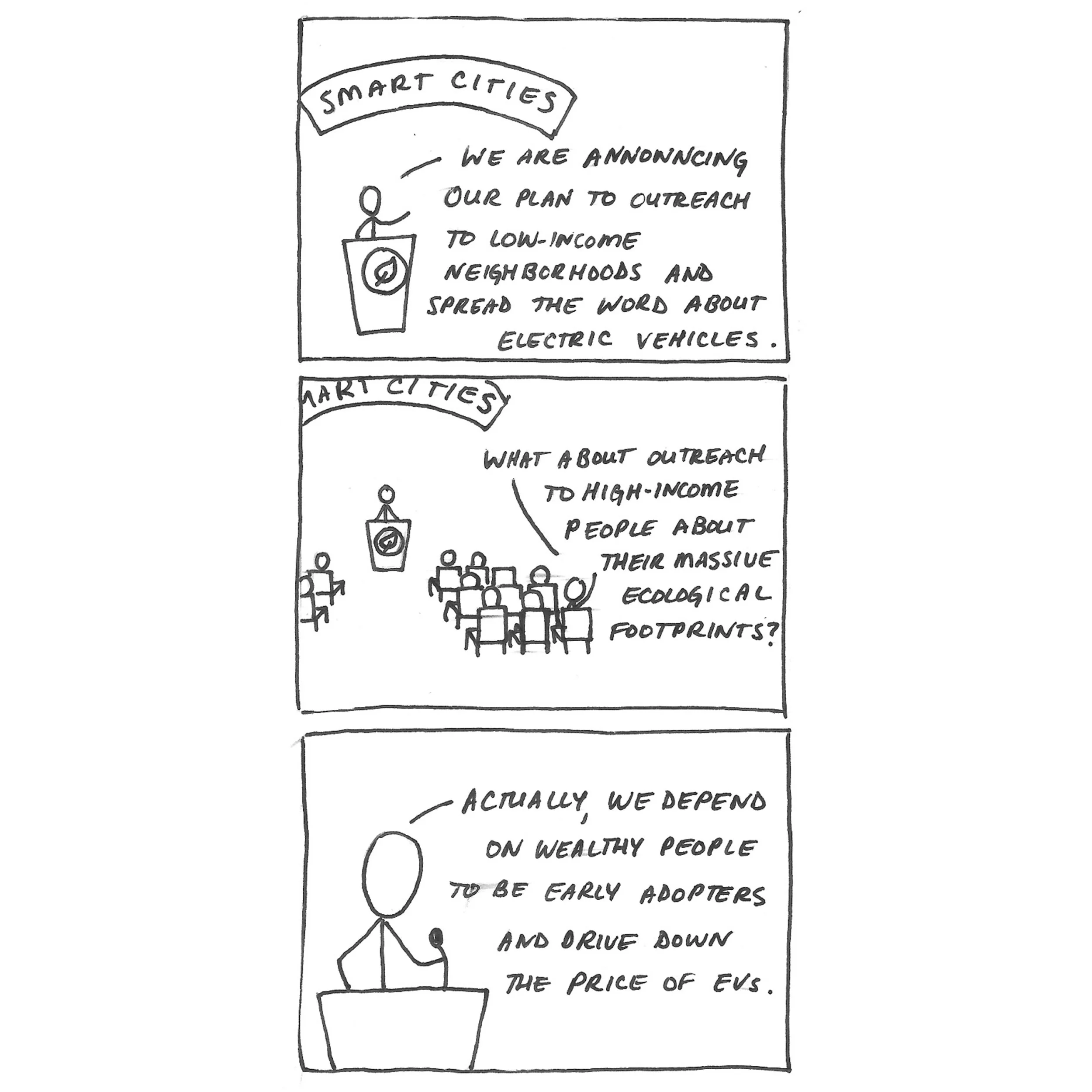
Here's an interaction I witnessed at an academic conference on "Smart and Sustainable Cities." I've told this story many times to colleagues, friends, and fellow environmental researchers, so I decided to illustrate it.
The point? Advocacy for electric vehicles is largely based on claims of reducing environmental impact. But the current EV rollout effort does nothing to address limits on total wealth and resource demand. In fact, I believe the average Tesla driver feels a sense of eco-righteousness, freeing them from worry about their ecological footprint.
When this question about outreach to wealthy people came from the audience, it was treated as awkward and out of place. But I think it touched on the exact socio-ecological blindspot that is actively undoing all the potential benefits of decarbonization technology. -
#49: Bike Terminology
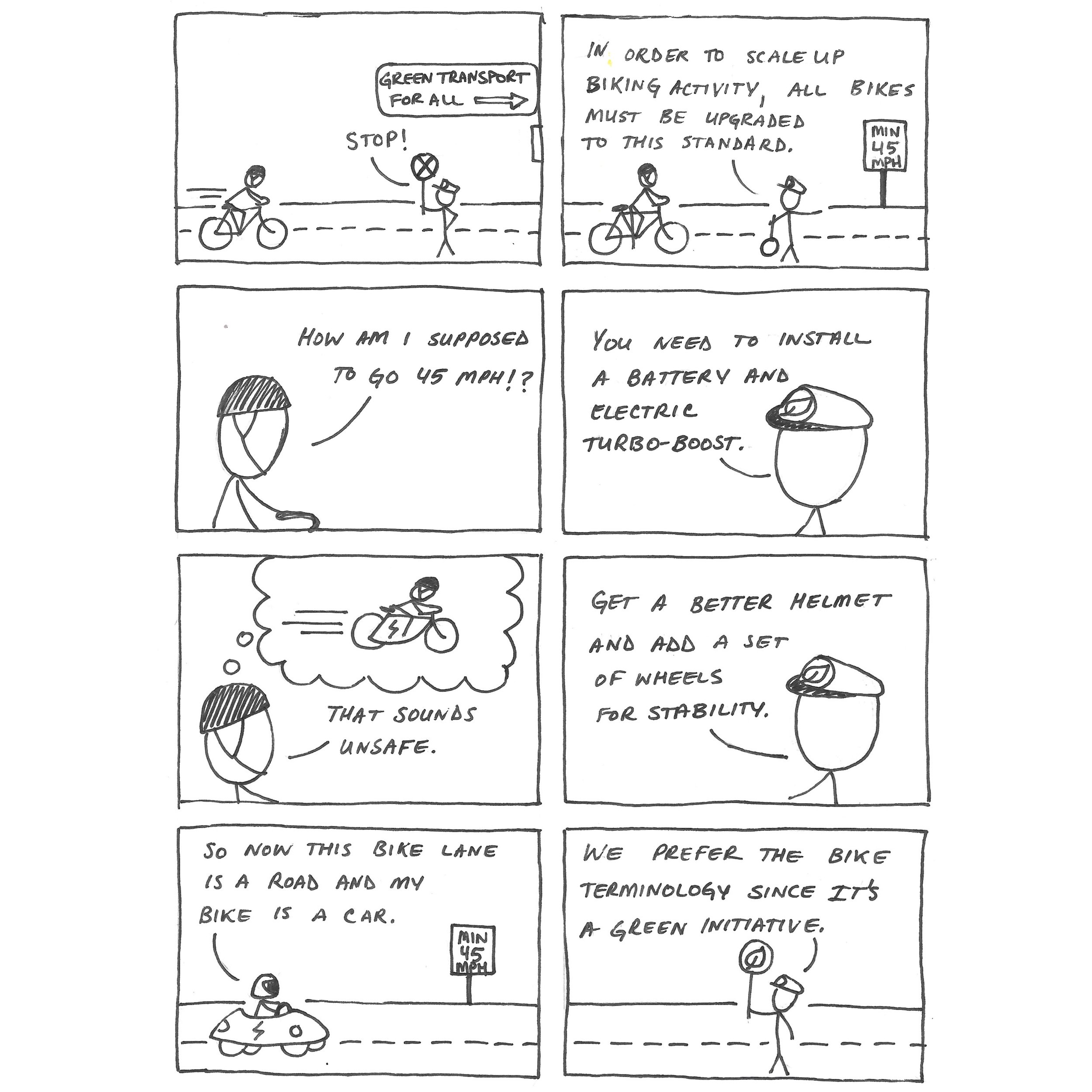
Popular visions of a green future tend to sound like this:
🟢 SOLAR PANELS ON EVERY ROOFTOP
🟢 ABUNDANT RENEWABLE ENERGY
🟢 GREEN TRANSPORTATION FOR ALL
What’s missing from these visions is the enabling technologies that support #greentech scale-up. You can't just slap #solarpanels on everything and have an electricity system as high-power and on-demand as the one we're used to. The scaled-up version requires energy storage, transmission infrastructure, and cyber-controls. These features are all technically possible – they are being implemented as we speak! But it should be clear that they add up to something much more material and non-renewable than “solar panels on every rooftop.”
In trying to provide the same convenience and abundance that our fossil-based system provides, we are following the same ecological missteps that have brought us phenomena such as climate change and biodiversity loss. We're just calling it “green” so we can feel good about it.
Do we need an energy transition?
Yes, absolutely.
But we also need to orient the new system toward slower speeds and achievable limits on extraction/use of environmental resources. -
#50: Cleantech Bingo
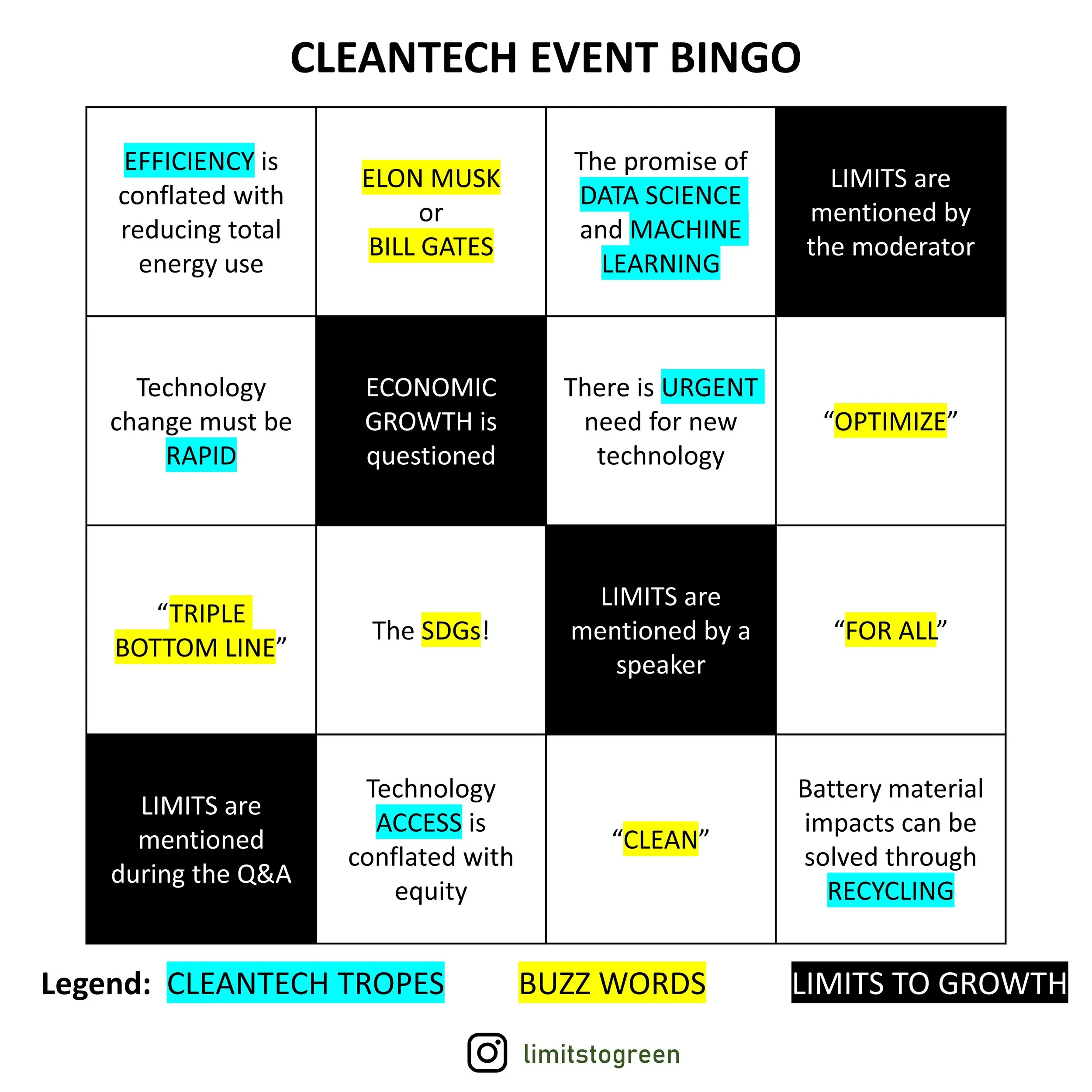
I recently attended a Stanford Alumni Association / Stanford Energy talk, part of a series called "Accelerating Climate Solutions." I made this BINGO card for myself ahead of time and included many of the tropes and buzzwords we are used to hearing in conversations about cleantech. Note that it is also designed so that you can't win unless, some how some way, the audience or speakers discuss limits to growth.
Almost a win!
The takeaway? This new Stanford University School of Climate & Sustainability must overcome the focus on materially-engineered "solutions" to the climate crisis. Without a sense of limits, they do not fit within the macroeconomic realities we are facing.
Sustainable = Sustainable Planet. Not more climate tech algorithms and gadgets. -
#51: Smart Crawler
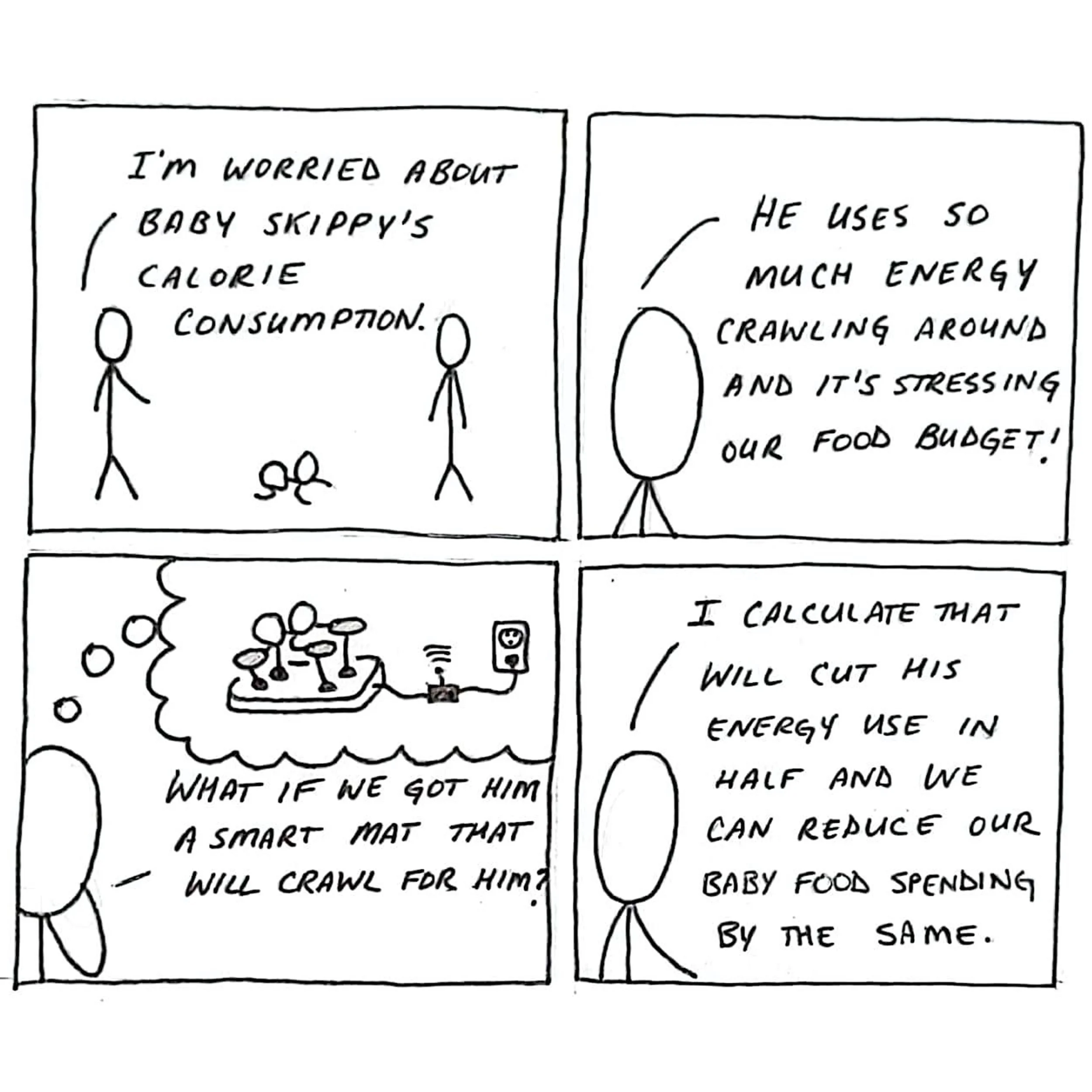
I've heard a lot of news lately about the Chicago “Smart Lighting” program, which involved updating street lights from high-pressure sodium to LED and adding some sensors/data-tracking to streamline maintenance. Or the White House Climate Office program to incentivize more efficient light bulb replacements.
Both entities are reporting that these programs will "cut emissions." From an environmental science, engineering, and economic standpoint, that is a ridiculous claim. Almost as ridiculous as this parent who thinks that a "smart" crawling machine will reduce their child's need for calories and will cut the family's food budget. Why?
a) A growing economy, just like a growing baby, needs more energy inputs over time. And any savings made in one sector will be used to meet pent-up demand in another sector. Probably Baby Skippy will use his saved crawling calories to bob his head around more. To cry and laugh more, and avoid going the f* to sleep. To grow his body and brain!
b) Just like so many "smart" projects we tend to ignore the environmental inputs to the cyber infrastructure on which they rely. Did this parent account for the increased internet and electricity bill that will come with their smart crawler? A huge blind-spot for environmental impact assessment that I have pointed out in my research.I’m not saying these efficient lighting programs are bad for the city/our nation, what I'm saying is that the environmental claims being attached to it are false if not purposely deceitful.
-
#52: Growth Curves
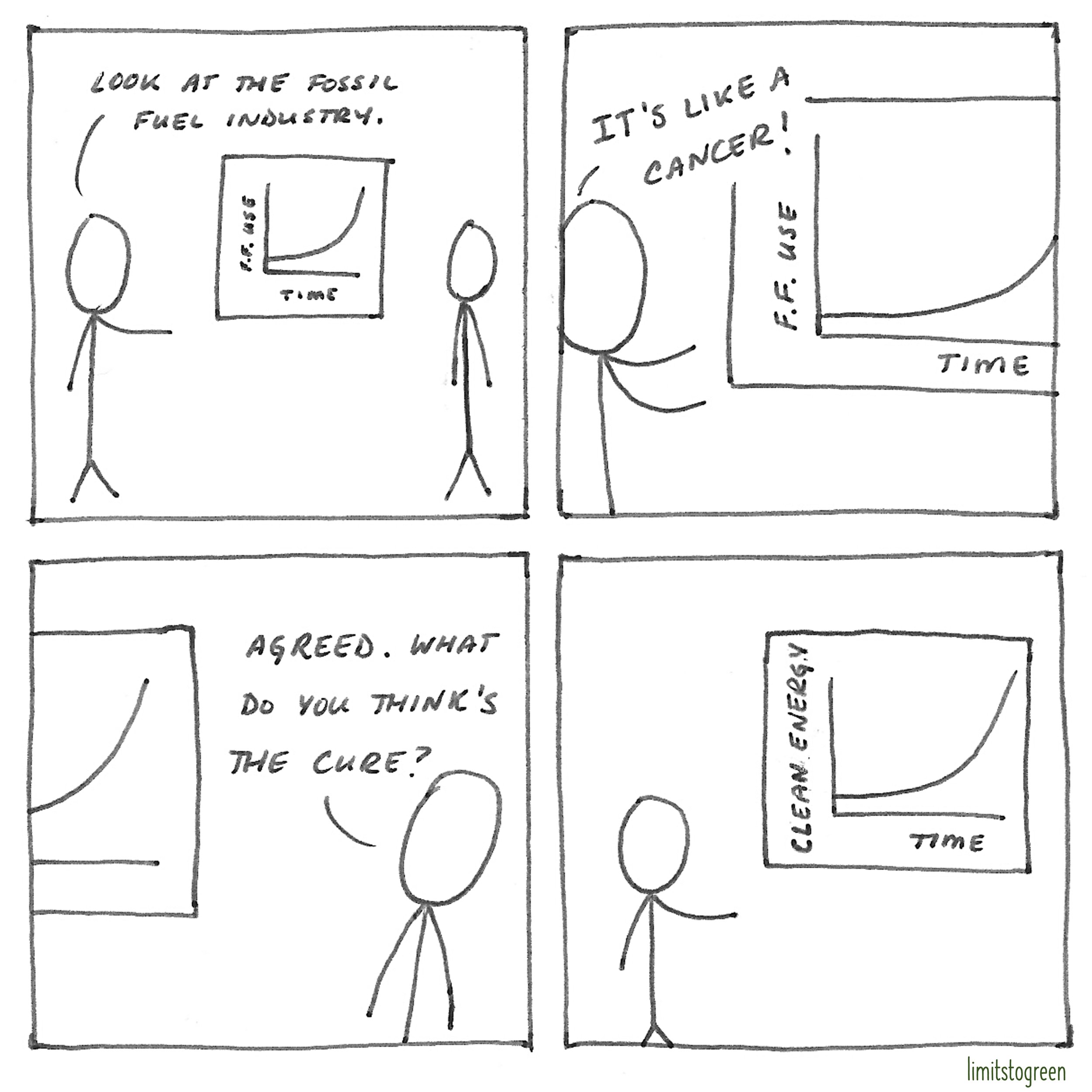
Direct quote from John Doerr's recent book - Speed and Scale - proposing a fully technological fix for the climate crisis: “While betting on clean technology was once seen as risky or rash, it's beginning to be seen as the express route to economic growth."
You can't fight environmental disaster growth curves with exponential extractive growth curves. But somehow it's become a best-selling idea. -
#53: Unicorn Poop
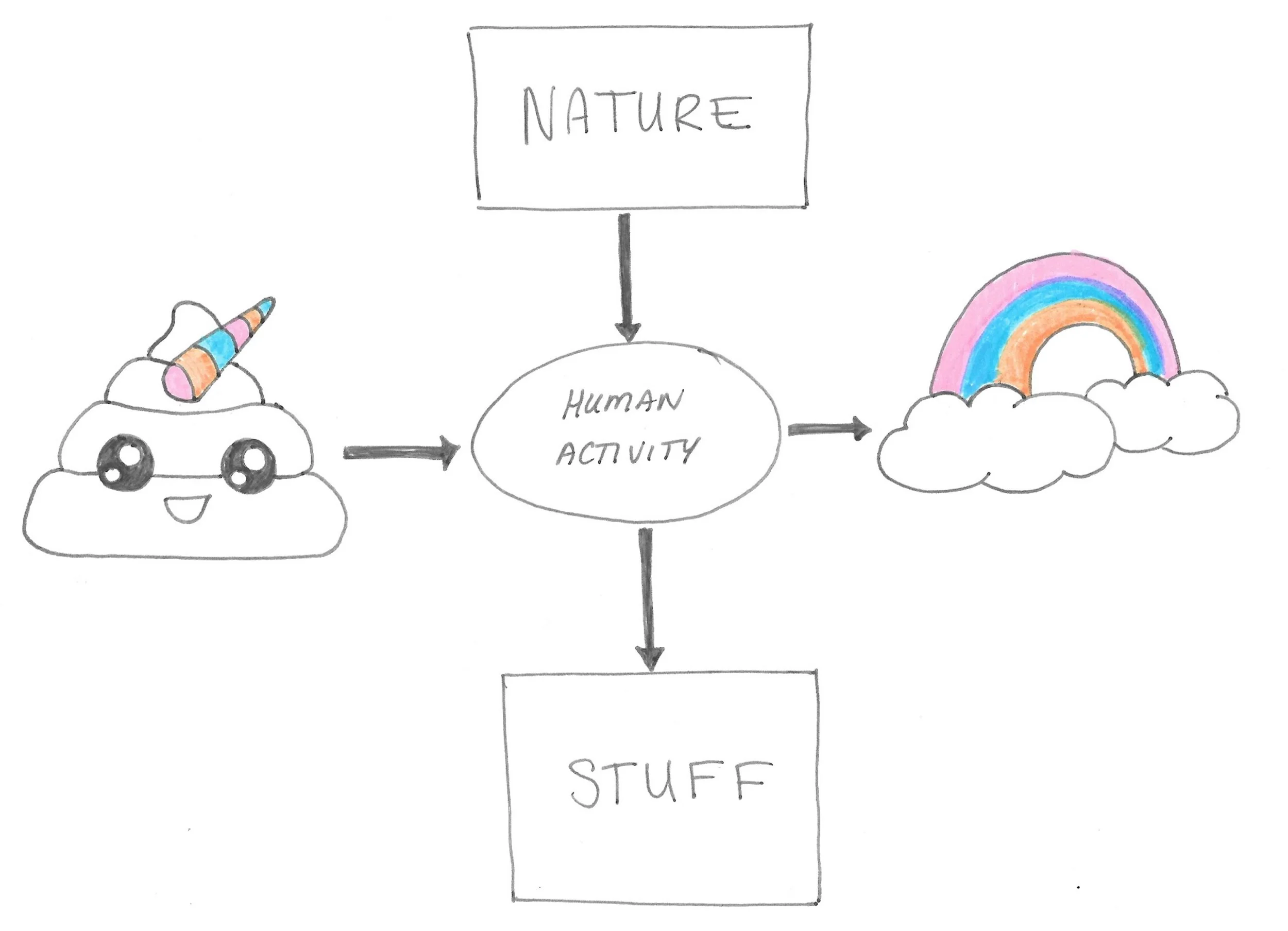
Let's say we found the ultimate clean, cheap, and abundant energy source. Freely available, widely distributed, and with no toxic effects when used. I call this the "unicorn poop" scenario.
In the current mainstream approach to sustainability, such a scenario would be an ECOLOGICAL DISASTER. Why? Because we use energy to DO THINGS. To make things, to alter our surroundings, to claim more Earth for ourselves. We don't just need clean energy, we need a limits framework for managing the resources of our one globally-shared Earth system. -
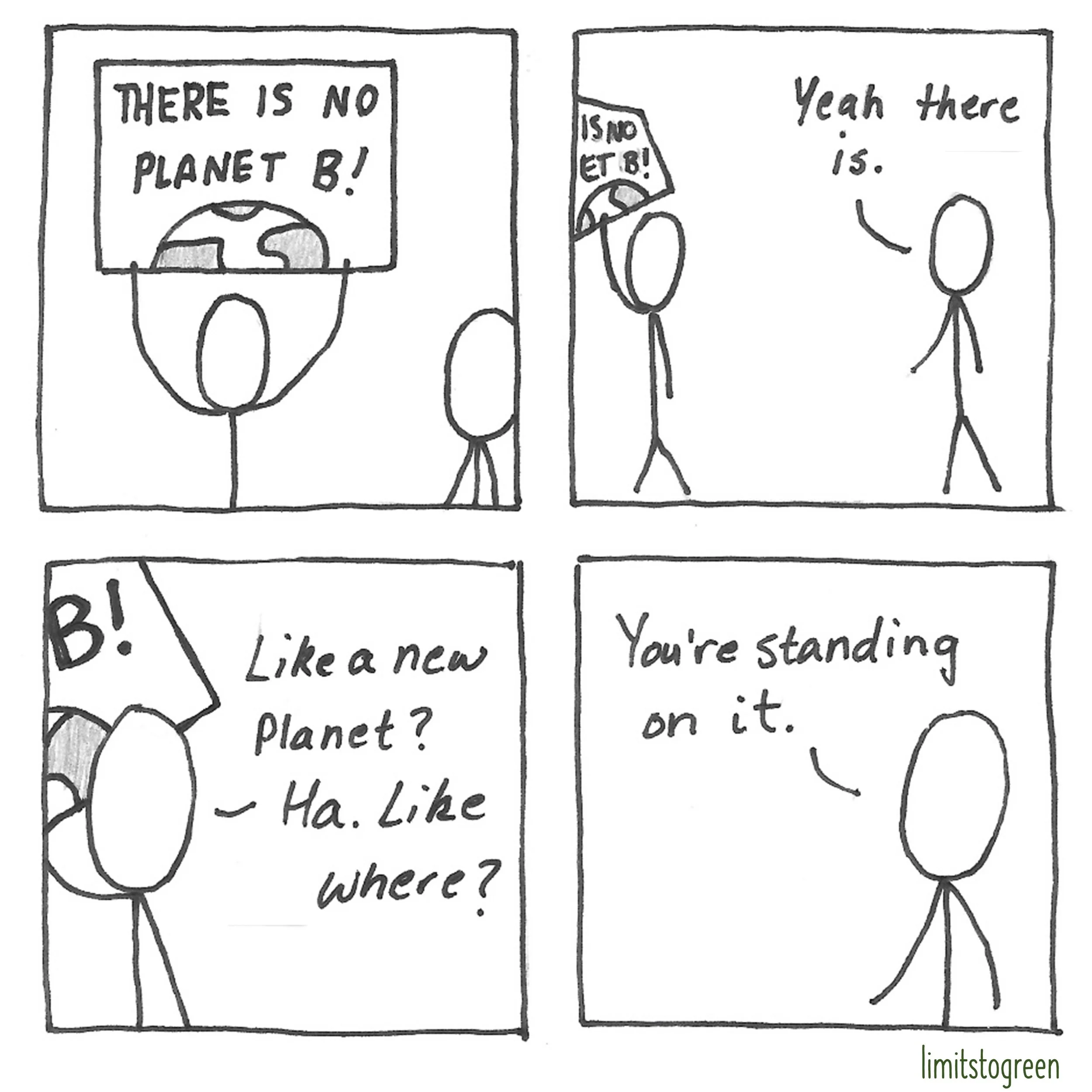
#54: Planet B
I see these "There is no Planet B" signs all the time at environmental rallies. I've been the proud holder of such a sign before! But increasingly I'm thinking... there is actually a Planet B - we live on it. The recent IPCC Report on the state of global change highlighted this for me.
Planet A was the planet in which humans weren't yet the main driver of global environmental change. We had many local environmental problems, which were solved with technology and pollution management schemes.
Now here we are on Planet B and we're treating the global ecological problem like we used to treat the local ones - with technology and calls for "rapid" and "urgent" scale-up. We must face life on Planet B with a much longer view of things, and cooperate globally to enact limits on resource extraction and use. -
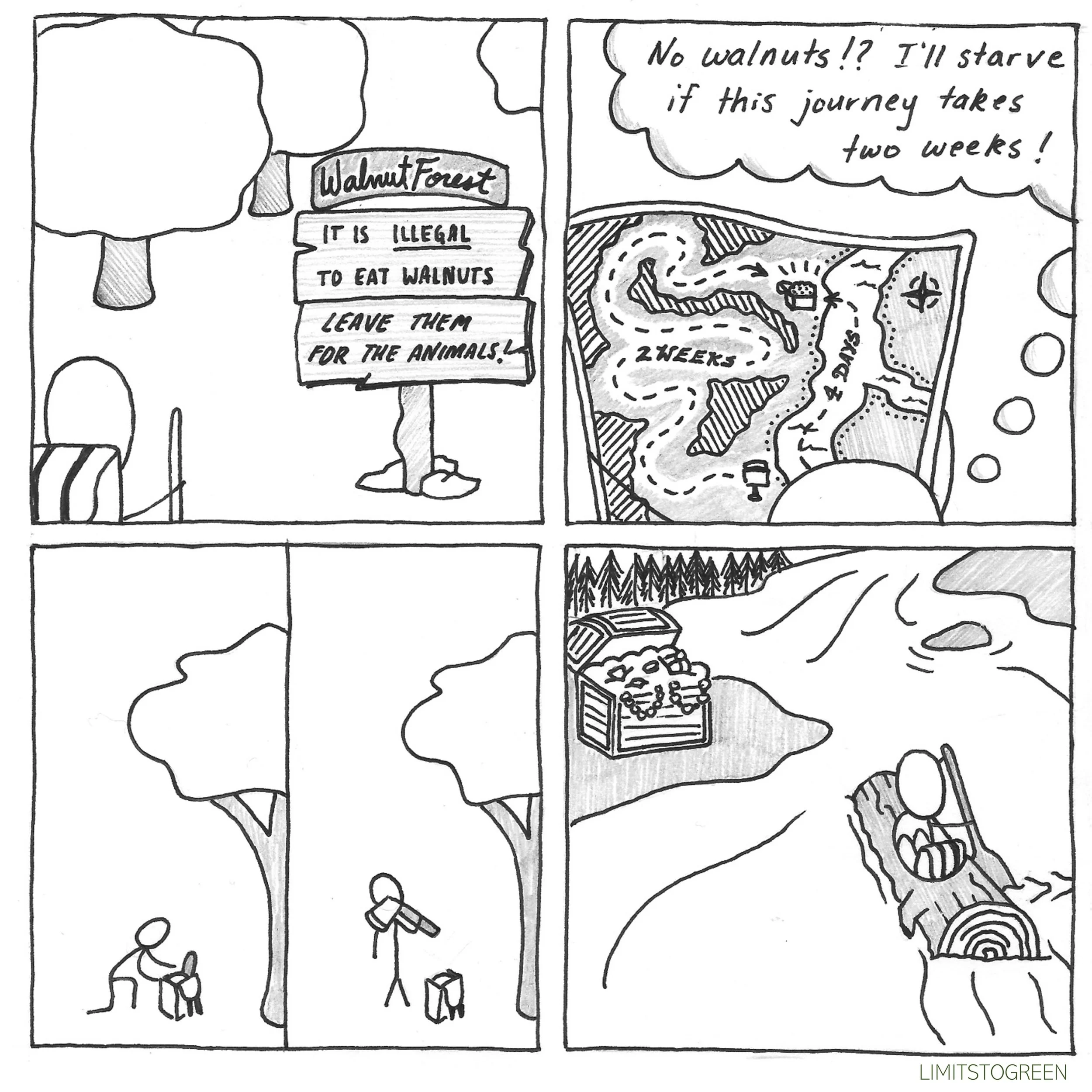
#55: Treasure Hunt
A treasure hunter planned to survive the long trek through Walnut Forest by harvesting and eating nuts. At the entrance to the forest is a warning: Walnut-eating is illegal! Too many hikers have been eating up this precious food source for the local wildlife.
Now, this is a law-abiding but treasure-hungry traveler, and the sign didn't say anything about cutting down trees. So why not raft the river in a walnut tree trunk? It's not illegal, as long as you leave the nuts behind...
This is exactly how I see the clean energy movement proceeding. The rallying cry is "don't burn fossil fuels," but it is not paired with any call for limits on economic activity or the materially-extravagant ends for which we operate the economy. So, humanity may eventually go along with "don't burn fossil fuels" but not until it has found many more non-combustion ways to use them, and found an alternative set of abundant materials to draw energy from, all to achieve the same ends. And with alternatively large-scale ecological destruction to go along with them. -
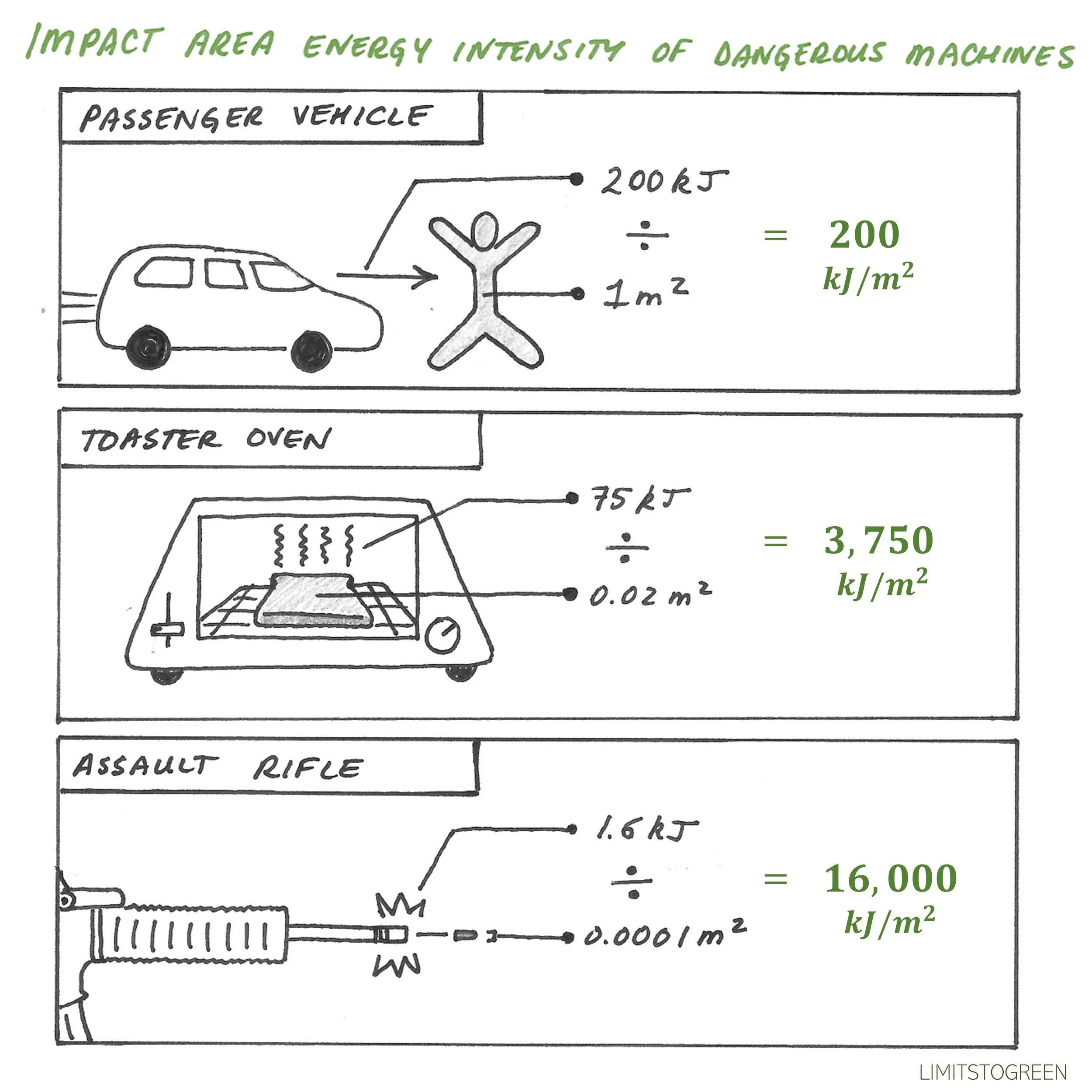
#56: Everyday Machines
While thinking through the nation's experience with firearms, and the debate surrounding gun ownership, I started thinking about how we might compare various everyday machines on an energy basis. I settled on IMPACT AREA ENERGY INTENSITY as a starting point. How much energy does a given machine exert per unit of area, in a potentially fatal use case?
Back-of-the-envelope calcs:
🚘Car hitting human: 200 kJ/m2
🔌Toast about to catch fire: 3,750 kJ/m2
🔫Bullet shot from a rifle: 16,000 kJ/m2
Comparing regulation of firearms and regulation of other consumer products and sectors of the economy is not new, but I haven't seen it put in terms of energy before. I realize this is a sensitive topic and I'm not trying to downplay the super-important social and political elements involved. However, energy is the fundamental physical unit behind dangerous events, so maybe there is some common ground to be achieved here too. -
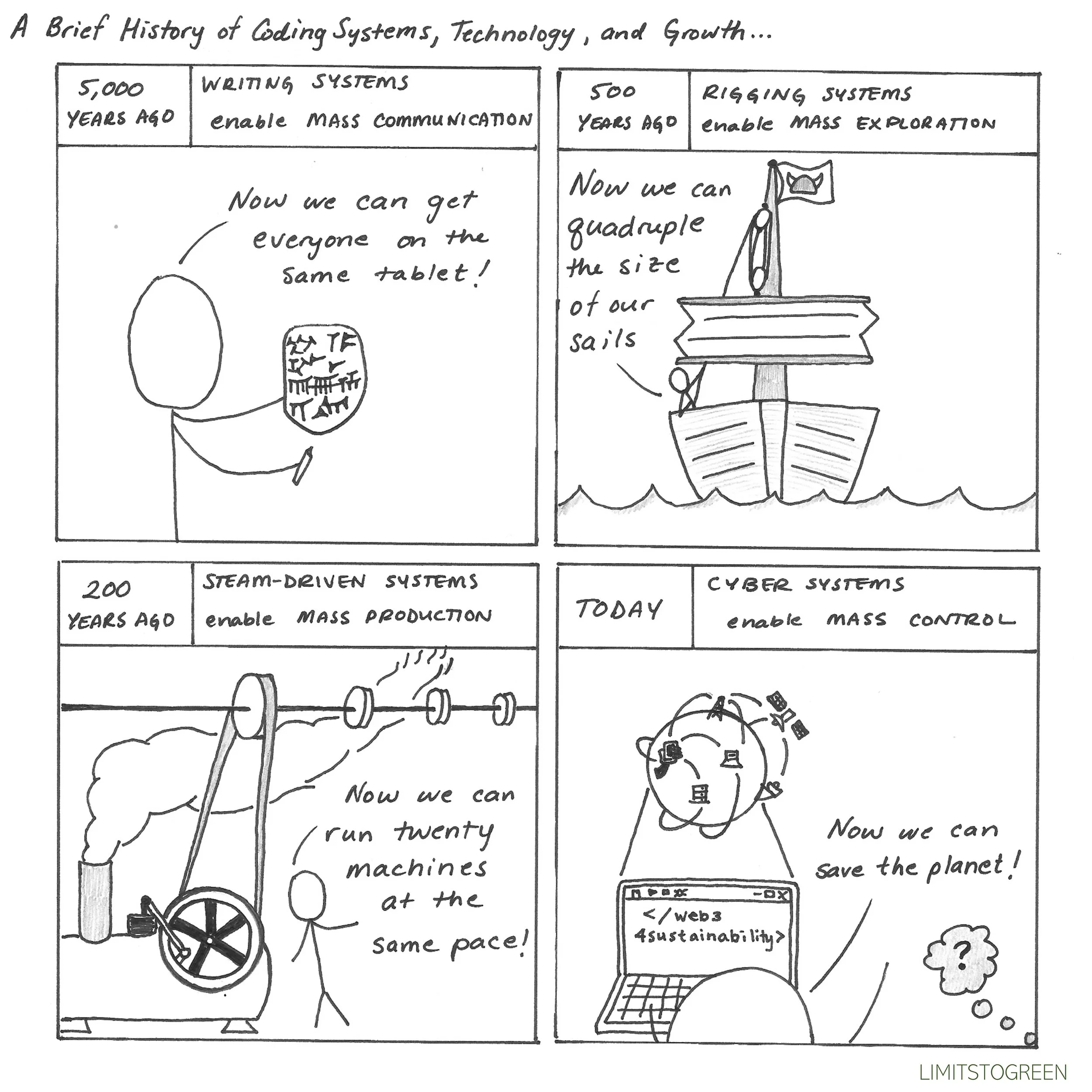
#57: Coding Systems
We hear all sorts of green marketing lines about how apps, algorithms, and the internet can "unlock" efficiencies, enabling lower emissions, less environmental impact, etc. But there is nothing inherently environmental about the internet. I think of it as just the latest mechanism humans came up with to control people and machines. It's a coding and communication system.
What I'm claiming in this week's limits to green comic is that the internet is literally and physically the latest update to a control system that goes way further back than the industrial revolution.
If we do ever achieve global environmental impact reductions, it will be primarily because we enacted limits on the size of that control system, not because we tweaked its material configuration. -
#58: Sustainability Acronyms
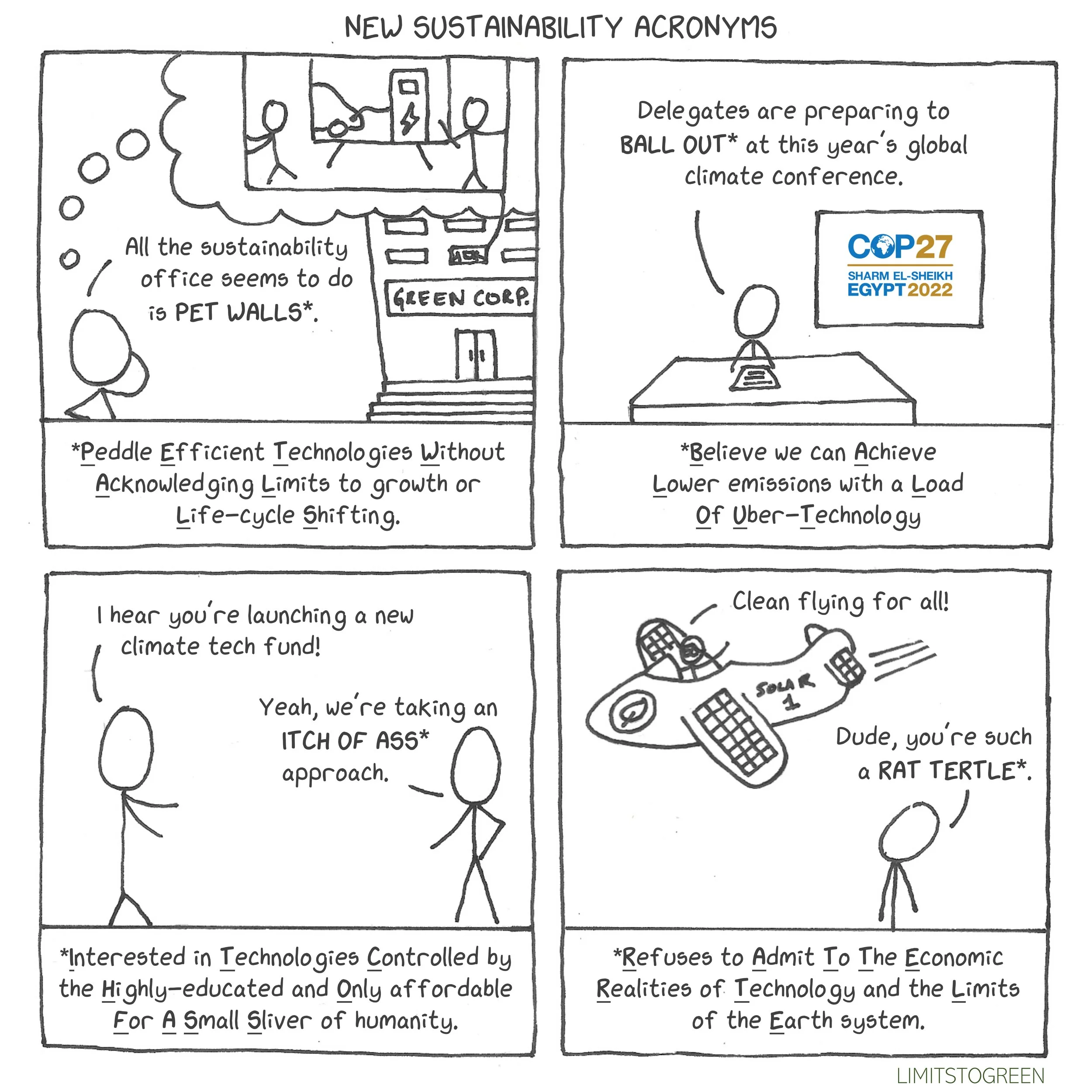
This happened while writing up an academic paper on electric vehicles. I use at least 20 acronyms in the paper - BEV, PHEV, ICEV, EVSE, GHG, to name a few. Well, I thought, how might I summarize my overall thoughts on sustainability techno-solutions, in one single acronym?
Here are four options: PETWALLS, BALLOUT, ITCHOFASS, and RATTERTLE (: -
#59: System Levels
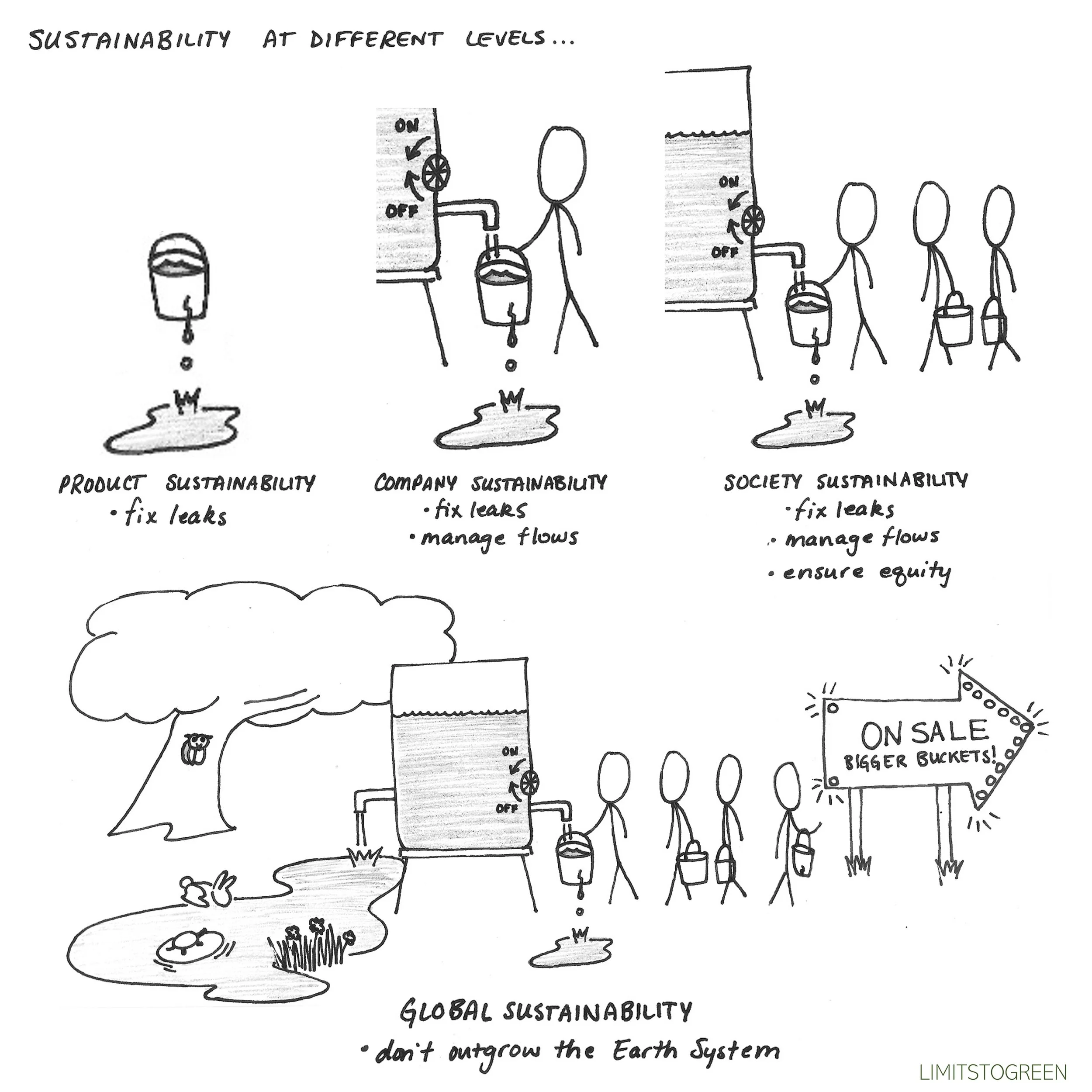
Next time you see a corporate or government claim about "sustainability" see if you can place it in one of these system levels.
In my observation, most claims fall into those along the top: PRODUCT, COMPANY, SOCIETY.
Rarely do we encounter an honest depiction of the global picture, that we - i.e. all of humanity - must somehow limit our draw on ecological stocks and flows. The other three levels do not guarantee this. Fixing leaks, better-managing flows, and ensuring equity... these are noble goals that must ultimately fit within our one Earth System.
As we cheer for sustainability plans, new technologies, and poverty-alleviation efforts, let's not forget to grapple with that last and most difficult part - the One Earth System. -
#60: Europe Envy
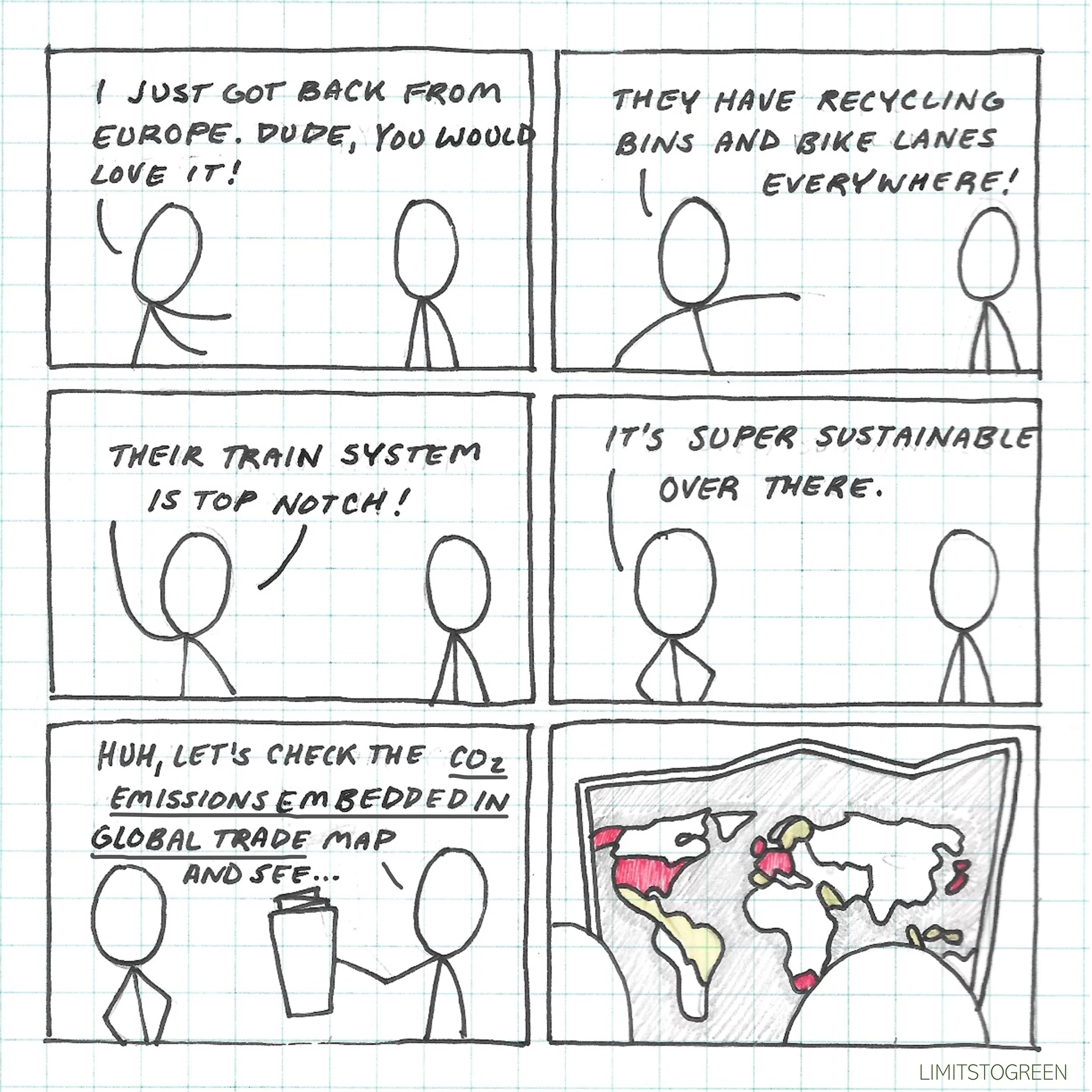
Sustainability advocates in the US suffer from a bad case of Europe-envy. We are constantly hearing about how great things are for the environment across the pond. Denmark's bike culture, France's amazing train system, Switzerland's zero-waste policies, and Germany's groundbreaking renewable energy incentives.
But we are kidding ourselves if we think Europe has it figured out. They may have picture-worthy recycling bins and green-leaf logos galore but, on the whole, their economies are structured the same as ours. First, they rely on an extreme trade imbalance which causes most of their emissions to be emitted outside of the continent - in the places where resources are extracted and processed into goods. Second, their "environmental" policies do not communicate any intent to rectify this balance. Third, their embedded-emissions footprint is still massive.
Trade-embodied emissions data
Map sketch inspiration
MAP LEGEND:
yellow = unsustainable trade-embodied emissions
red = super unsustainable trade-embodied emissions -
#61: Have Less Money
What is money? It's a claim on resources. Physical resources, from the Earth System.
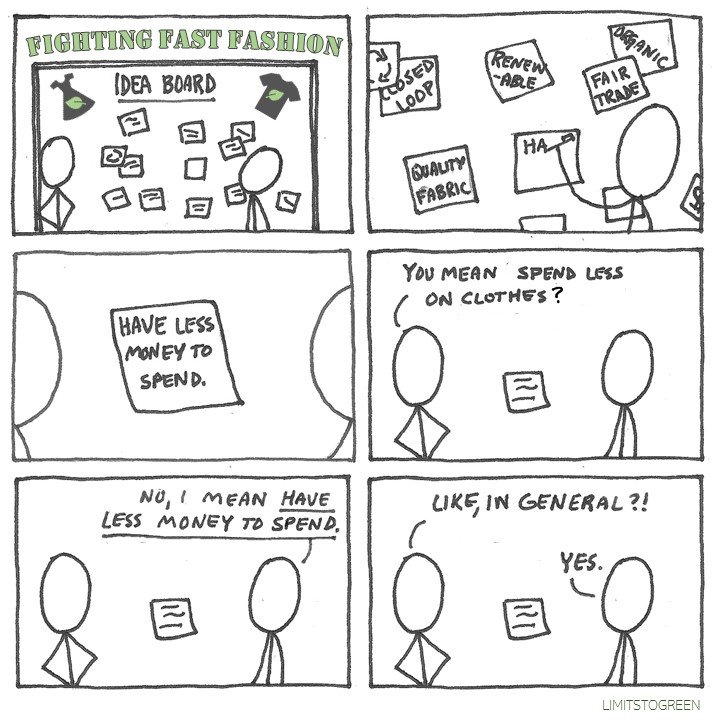
There are tons of great solutions for making products - like clothes - less impactful. Organic cotton instead of conventional; fair trade certification for clothing brands; thrift shopping and durability instead of fast fashion.
But hasn't it's become too easy to get lost in a specific sector and its product-level standards and forget to address the WHOLE? The whole is tough to imagine and it's tough to communicate. How about "have less money to spend"? I think it communicates the right idea, on average. And I don't mean spending less just on clothes, or travel, or a single category of goods and services. On everything. Like, in general. -
#62: Eco-Solutions
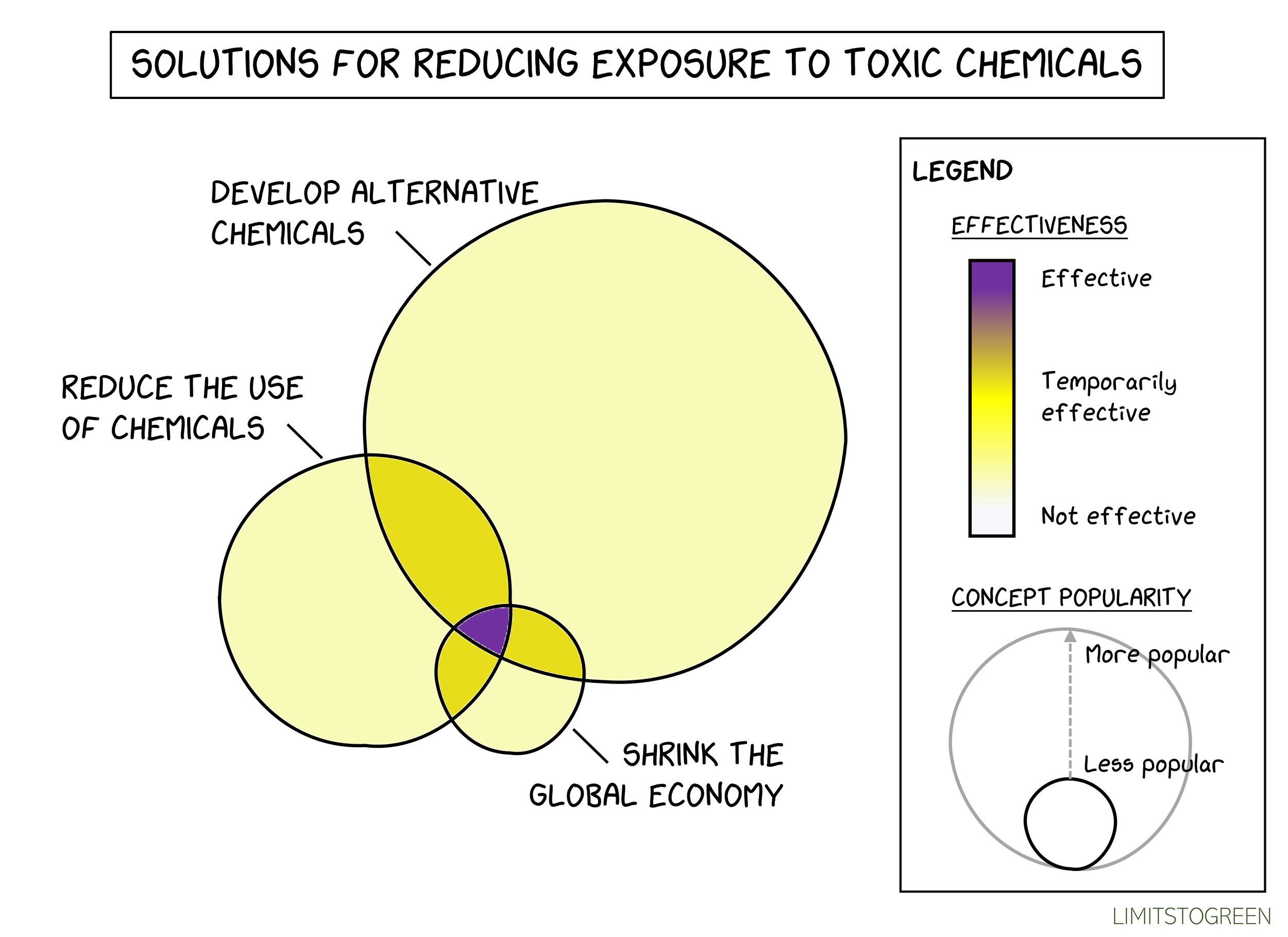
The mainstream environmental movement is mostly about proposing profitable alternatives to environmentally-damaging products. There is some talk of "reducing" - toxic chemicals, carbon emissions, water use, etc. - but most of it takes an efficiency approach that is undone by rebound effects.
Degrowth is not opposed to alternatives and efficiency as solutions. It is an additional condition on them. Degrowth says: without a limit on the size of the economy, the mainstream environmental solutions - alternative chemicals, responsible products, renewable energy, efficient appliances - will never be effective.
Economic size is not the only problem. It's a part of the problem that gets the least attention. -
#63: Environmental Footprint
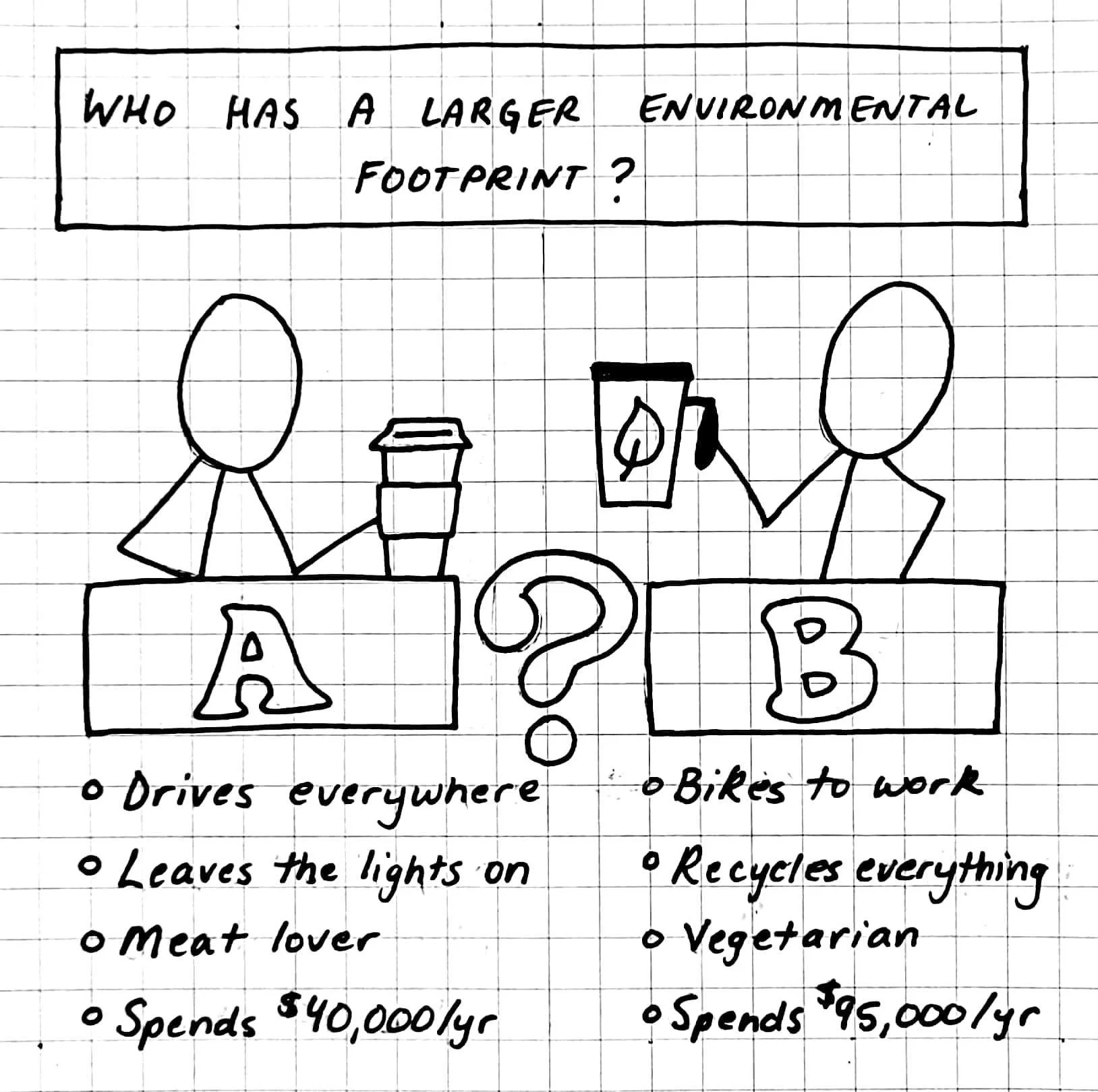
One huge problem with footprint calculators is that they make it seem like your environmental impact is a function of consumption decisions that we all share: how we get to work, what we eat for dinner, how we handle our household appliances, etc. Calculators rarely question the overall economic context. If you spend more in total, you're paying for more economic services in total. I think spending - as demand for stuff and services - should weight negatively on footprint calculations.
BUT, perhaps there's a possibility spending can be eco-positive? If it goes toward ecosystem protection/restoration?
There's no right answer to the question this comic poses... just lots to debate!