Cleantech: A History
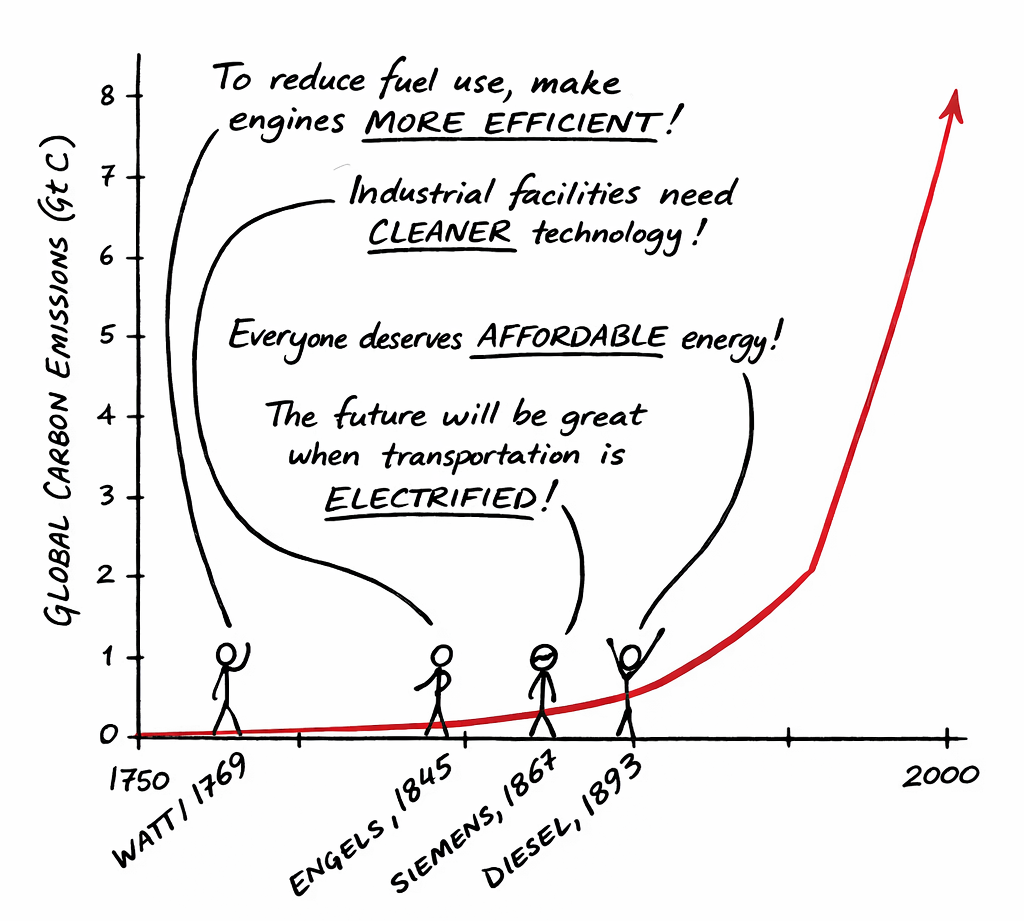
CLEANER, MORE EFFICIENT, AFFORDABLE, and ELECTRIFIED. These were prominent features of the innovation conversation over a century ago. That’s when the industrial growth patterns that are now destroying the planet were just taking shape at-scale.
If we want these buzzwords to drive actual environmental reductions, at a global scale, then we need a global cap on resource extraction and use.
About the graph:
- red line depicts global carbon emissions from human activity, from 1750-2000.
- some famous technologists are staged along the time-axis, with a modern paraphrase of ideas they published in that year.
Carbon emissions data simplified from: https://skepticalscience.com/print.php?r=137
1769 - James Watt's steam engine patent, "My new invented method of lessening the consumption of steam and fuel in fire engines": https://upload.wikimedia.org/wikipedia/commons/0/0d/James_Watt_Patent_1769_No_913.pdf
1845 - Friedrich Engels' "Condition of the Working Class in England" calls repeatedly for "clean" construction and building technologies as a solution to the plight of factory workers https://www.gutenberg.org/ebooks/17306
1867 - Werner von Siemens dreams of electrifying everything, mostly trains: https://new.siemens.com/global/en/company/about/history/stories/first-electric-streetcar.html
1893 - Rudolf Diesel's vision for decentralized small-scale energy plants is smashed by the growth-inducing efficiency and power potential of his engines. See p.255 of Energy & Civilization (Smil 2017): https://www.google.com/books/edition/Energy_and_Civilization/Br74DwAAQBAJ?hl=en&gbpv=0